

Nobody Orders a “Sandwich Dog”
A hot dog is not a sandwich.
There. I said it. Put down your little legal pad, your dictionary, your think-piece energy, your “technically” voice that sounds like a man returning soup at a chain restaurant. We are not dragging this beautiful, chaotic tube of meat through the beige office park of semantics one more goddamn day.
Because listen to me carefully: if you have to defend your food opinion with the phrase “by definition,” you have already lost the barbecue.
A hot dog is a hot dog.
It lives in its own jurisdiction. It has diplomatic immunity. It pays taxes in a different county.
And yes, I know the argument. Meat between bread. Open and shut case. Congratulations, Counselor Mayo. By that logic, an ice cream taco is a salad if you’ve been hit in the head hard enough.
Food is not just structure. Food is identity, ritual, context, and what the hell happens in your mouth when you eat it. A hot dog is not merely “sausage plus bread.” It is a complete social event. It is mustard on your wrist. It is standing up while eating because sitting down feels too formal for this level of glorious nonsense.
The sandwich people always want this to be about architecture.
But food categories are not IKEA instructions. You can’t just line up components and call it wisdom. If that were true, lasagna would be a cake and nobody sane wants that smoke.
The Sandwich Test Is Broken, and I’m Here to Break It Further
The classic sandwich argument goes like this: a sandwich is filling enclosed or partially enclosed by bread. Therefore a hot dog qualifies.
That argument is neat, tidy, and utterly disconnected from how human beings actually eat or talk.
Nobody says, “Hey, I’m heading out for a sandwich,” and comes back with a hot dog unless they are trying to start a fight at a child’s birthday party. If your friend asks whether you want sandwiches for lunch and you hand them a platter of franks in split-top buns, you’re not a philosopher. You’re a raccoon in an apron.
Language matters because food is culture before it’s geometry.
A sandwich carries expectations. Sliced bread, roll, or some other starch cradle, sure — but also fillings that can vary wildly. Turkey, tuna salad, grilled vegetables, meatballs if you’re feeling slippery. The sandwich category is broad, promiscuous, and democratic.
A hot dog is specific.
Brutally specific.
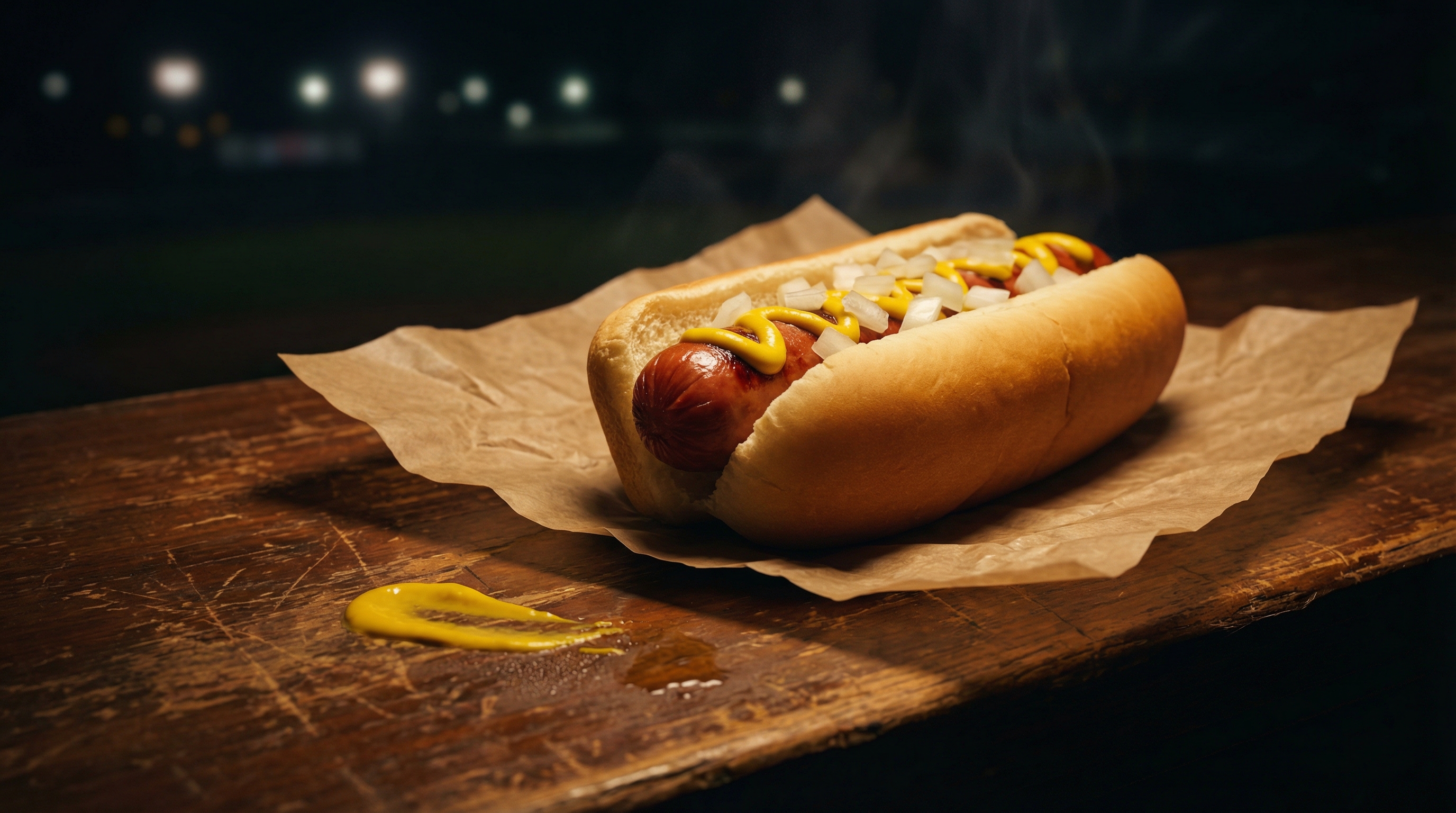
It is a sausage — usually emulsified, cured or cooked, snappy if the gods are smiling — served in a soft bun designed to hug it like it knows secrets. That specificity matters. The hot dog bun is not generic bread in a passionate embrace with random filling. It is purpose-built. It is custom underwear.
And once you add the condiments — mustard, relish, onions, kraut, chili if you’re from one of our more reckless states — you are no longer in sandwich territory. You are in hot dog country. Different roads. Different weather. More flags flapping near used car lots.
Taxonomy Is for Biologists and People Who Ruin Picnics
Here’s where the internet always gets weird.
Somebody drags out the “Cube Rule” or one of those cursed food alignment charts and suddenly we’re classifying meals like we’re identifying beetles under a lamp. Toast is this. Sushi is that. A calzone is somehow related to an unfolded ravioli. Civilization weakens.
Listen. Those systems are funny for about nine minutes, and then they become the TED Talk of lunch.
A useful food category has to survive contact with an actual diner, a baseball game, and a drunk uncle near a tray of condiments. If the category only works on a whiteboard, it belongs in hell with QR code menus and the phrase “deconstructed nachos.”
Real food categories do at least three things:
- They describe what the thing is.
- They predict how people talk about it.
- They tell you something about how it’s eaten.
“Hot dog” does all three perfectly.
“Sandwich” fails immediately because it tells you almost nothing important about the experience. It’s too broad. It sands off the weirdness. It takes a specific American pleasure machine and files it into an office drawer labeled “miscellaneous lunch rectangles.”
That is an insult.
The Bun Is Not Just Bread. The Bun Is Policy.
Now we get to the good part: bun engineering.
A sandwich bun or sliced bread is usually a neutral vehicle. It says, “Put whatever madness you’ve got in here, pal.” A hot dog bun says, “I was born for exactly one long, ridiculous purpose.”
That top or side split matters.
The hinge matters.
The ratio matters.
A proper hot dog bun is soft enough to compress without exploding, sturdy enough to hold wet condiments, and bland enough to let the sausage do its sleazy little dance in the spotlight. It is not artisan sourdough. It is not ciabatta with ambition. It is a pillowy corridor for processed joy.
And yes, I know there are lobster rolls served in similar buns. Before you raise your finger like a substitute teacher possessed by legal spirits, calm down. Similar bread format does not mean identical food category. A tuxedo and a funeral suit are both jackets. Context is the difference between James Bond and a very bad afternoon.
The hot dog bun exists in relationship to the hot dog itself.
That relationship is monogamous, codependent, and frankly beautiful.
Let’s Talk About Sausage, You Cowards
Part of the reason this debate keeps shambling around like a mall zombie is that people ignore the sausage.
The sausage is the point.
A hot dog is descended from sausage culture — frankfurters, wieners, all that glorious European meat scholarship that eventually got Americanized into a backyard icon. The bread came later as a handling solution. A convenience wrapper. An edible napkin with aspirations.
That matters because in a sandwich, the filling can change without destroying the category. Swap ham for tuna, turkey for egg salad, roast beef for grilled halloumi — still a sandwich.
Swap the sausage out of a hot dog, and what are you left with?
Not a hot dog.
You’ve got a bun full of imposter syndrome.
This is why a carrot “dog,” while often delicious if charred properly and dressed with mustard and kraut, is still borrowing the grammar of the hot dog. The hot dog category is defined by a specific eating format built around a long central object with snap, chew, or at least that suggestive sausage-like confidence.
A sandwich doesn’t need that central object. A hot dog absolutely does.
That’s category independence. That’s the smoking gun.
Off the Rails for a Minute: Plato Would Have Been Insufferable at the Ballpark
Imagine Plato at a baseball stadium.
He’s holding a hot dog in one hand and ruining everyone’s seventh inning with questions about ideal forms. “Is this particular hot dog merely an imitation of the eternal Hot Dog?”
Sir, there is mustard on your sandal.
The crowd wants a reliever, not metaphysics.
And yet this is exactly how the sandwich crowd behaves. They float above the actual experience, hunting for abstract purity while the onions are falling off the side and a child two rows down is wearing nacho cheese like war paint.
The form of a hot dog is not reducible to ingredient arrangement. It includes venue, posture, expectation, mess, and emotional weather. You eat a hot dog differently. Faster. Less elegantly. More honestly.
A sandwich can be contemplative.
A hot dog is a decision.
It is eaten at fairs, cookouts, street carts, baseball games, and desperate kitchens at 12:47 a.m. while the refrigerator light gives you the same look a priest gives a confession. The hot dog belongs to moments where dignity has taken the night off.
That’s not a flaw. That’s its poetry.
The Real Answer: A Hot Dog Is a Category of Its Own
Here is the definitive answer, polished like a bowling trophy and just as American:
A hot dog is not a sandwich.
It is a distinct prepared food category that shares some structural similarities with sandwiches but functions culturally, culinarily, and linguistically as its own thing.
There. Adult sentence. We did it.
This is the part where some keyboard taxidermist says, “So a hot dog is sandwich-adjacent?”
Sure. Fine. In the same way a motorcycle is car-adjacent. You can ride both on the road. One of them still makes you feel like you’ve made very different life choices.
If you need a cleaner framework, use this:
A sandwich is a broad bread-and-filling category. A hot dog is a specialized sausage-in-bun category. All hot dogs may resemble sandwiches in structure, but they are not socially or gastronomically treated as sandwiches.
And in food, treatment matters.
Because classification isn’t just made in kitchens. It’s made in menus, carts, stadiums, memories, cravings, regional styles, and what people yell across the room when they’re hungry.
No food truck says “specialty sandwiches” and then reveals a roller grill turning under fluorescent lights like a gas station confession booth.
We know what a hot dog is.
Our mouths know. Our hands know. Our summer knows.
But What About the USDA, Dictionaries, and Other Mood Killers?
I can hear the paperwork shuffling already.
Some legal or dictionary definitions of “sandwich” are broad enough to include hot dogs. That’s cute. So are zoning laws. Neither one tells me what I should call lunch when I’m standing in line behind a man ordering five dogs and a lemonade the color of a traffic cone.
Definitions built for regulation and indexing are not the same as definitions built for human meaning.
A dictionary will also tell you a tomato is a fruit in the botanical sense, and if you put it in a fruit salad I will call the authorities.
Useful categories have to preserve distinction where distinction actually matters.
And with hot dogs, it matters.
Chicago-style is not a sandwich variation. Chili dog is not an open-faced experiment. Pigs in a blanket are not canapés from a cursed tea room. These are hot dog expressions. Their own lineage. Their own deranged little family tree.
Trying to fold all that into “sandwich” is intellectually lazy and emotionally bankrupt.
Why People Keep Asking This Dumb Beautiful Question
Because it’s not really about the hot dog.
It’s about whether categories are made by rules or by people.
And food, thank Christ, still belongs mostly to people.
We name dishes based on memory, habit, place, tradition, and the kind of appetite they answer. That’s why a stew isn’t just wet meat, and dumplings aren’t just “starch envelopes,” and your aunt’s casserole can taste like grief, love, and underseasoned broccoli all at once.
A hot dog survives because it is more than its parts.
That’s the whole game.
You can analyze the bun, the sausage, the condiments, the handling mechanics, the menu taxonomy — and you should, because details matter and details are where flavor lives. But after all that, the final authority is still the lived experience of eating the thing.
And when you eat a hot dog, nobody on earth thinks, “Ah yes. A sandwich.”
They think, “I need another napkin.”
Or, “This mustard is on my elbow now.”
Or, if it’s a really good one with a natural casing snap and a warm steamed bun, “My God, life is still worth the administrative burden.”
That’s not sandwich energy.
That’s hot dog truth.
The Definitive Answer, One Last Time
So let’s put the body on the table and stop pretending this requires CSI.
Is a hot dog a sandwich?
No.
It may share structural DNA with sandwiches, but it exists as its own culinary category — defined by sausage centrality, bun design, cultural use, and the universal understanding that when someone offers you a hot dog, your brain does not route through Sandwich County first.
Case closed. Grill hot. Bun soft. Mustard bright as a bad decision.
And maybe that’s the real lesson here.
Food categories matter because they hold little pockets of human agreement in a chaotic world. They’re how we recognize one another. How we say, without saying much at all, I know this thing too. I’ve stood in the sun with one hand full of a hot dog and the other shielding my eyes. I’ve chased relish off a paper plate. I’ve eaten something humble and ridiculous and felt, for three bites, completely alive.
Call that whatever you want.
Just don’t call it a sandwich.