



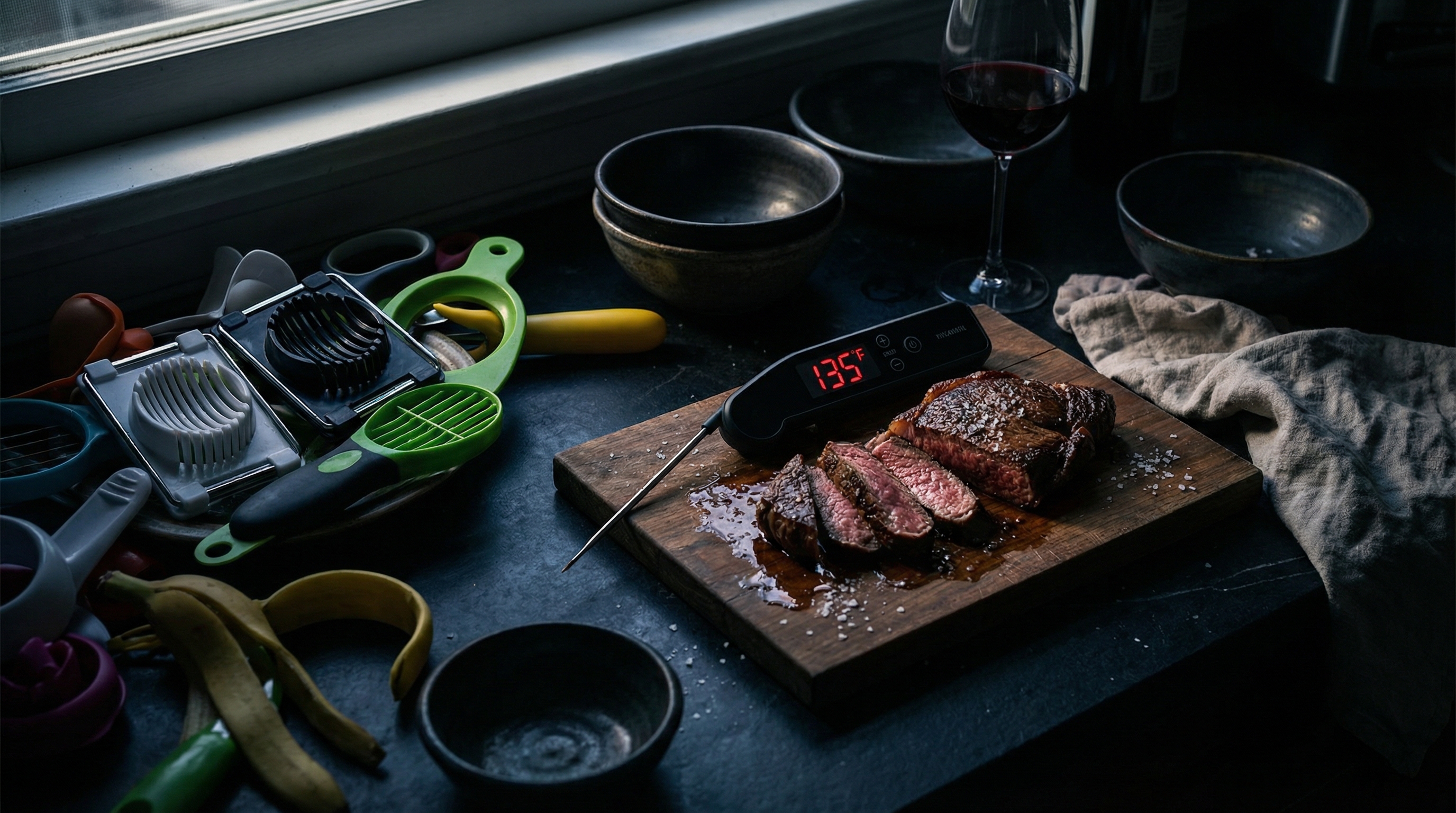
Kitchen Gadgets That Are Total Scams — and the One Tool That Actually Changed My Cooking Life
Let me save you a few hundred dollars and at least one junk drawer-induced emotional breakdown.
Most kitchen gadgets are scams.
Not illegal scams. Not trench-coat-in-an-alley scams. Worse. They are brightly colored, wedding-registry-approved scams. Tiny plastic monuments to the fantasy that the reason you’re not cooking more is because you don’t own a banana slicer shaped like a smile from hell.
Listen. You do not need a machine whose only job is to turn one hard-boiled egg into six identical damp moon slices. You need a knife. A decent pan. Salt. Maybe therapy. But not that.
The modern kitchen gadget industry is built on a lie so seductive it deserves its own saxophone soundtrack: that cooking is hard because you lack the correct object. That if you just buy the right hinged, suction-cupped, battery-powered little goblin, dinner will glide into your life on a cloud of garlic-scented competence.
Bullshit.
Cooking is not hard because you don’t own a strawberry huller. Cooking is hard because onions make you cry, chicken demands respect, and Tuesday arrives with the dead-eyed confidence of a tax auditor.
And yet.
There is one gadget — one — that actually changed my life in the kitchen. Not in an influencer way. Not in a “this changed everything” way where everything is somehow still sponsored and beige. I mean actually changed it. Made me cook better, faster, cleaner, with less swearing and fewer injuries that required me to explain myself to urgent care staff.
We’ll get to that glorious bastard.
First, we need to talk about the frauds.
The Single-Use Gadget Is a Cult With Packaging
If a tool only does one thing, it better do that one thing like a Swiss watch built by angry angels.
Most don’t.
The avocado slicer is ridiculous. I say this as a person who likes avocados and has absolutely suffered for guacamole. You do not need a green plastic snowshoe to split, pit, and slice a fruit that has been successfully handled by ordinary knives for generations.
Same goes for garlic peelers — those little silicone tubes that promise to free you from papery clove skin. Friend. Put the clove under the flat side of your knife, smack it like it owes you rent, and the skin falls off. It’s not witchcraft. It’s physics with attitude.
Egg separators? No. Let the yolk rest in the shell halves and pass the white back and forth like your ancestors intended. Or use your hand. Your hand is a spectacular kitchen tool. Wash it and stop acting surprised.
Pineapple corers are another one. They arrive in your life looking like a medieval instrument designed by a man forbidden from feeling joy. They make perfect spiral rings, sure, if the pineapple is exactly the shape the tool’s designer hallucinated. Otherwise you’re in there twisting and sweating like you’re trying to open a safe full of tropical disappointment.
And don’t get me started on herb scissors.
Five blades. Five! Like Edward Scissorhands got a job at a farmers market. They clog instantly, they bruise tender herbs, and cleaning them feels like flossing a tiny steel accordion. Use a chef’s knife. Rock it through parsley. Done. Move on with your life.
The Lie of "Convenience"
Here’s how the scam works.
A gadget promises convenience, but what it really delivers is a new object to wash, dry, store, and eventually resent.
The pancake batter dispenser seems convenient until the spring mechanism traps half-dried goo like a crime scene. The salad spinner seems convenient until it colonizes an entire cabinet shelf like some smug plastic UFO. The electric can opener seems convenient until it dies during a storm and you realize your grandparents survived the 20th century with a $12 manual one and stronger wrists.
Convenience is not just about using the thing. It’s about everything after.
Where does it live?
How annoying is it to clean?
Can it survive reality, or does one tomato seed send it into a full nervous collapse?
This is why so many gadgets become drawer fossils. They solve a five-second problem by creating a five-year storage issue.
And storage, my dear grease-stained companion, is where dreams go to suffocate.
Unitaskers That Somehow Get a Pass
Now, before the comments section starts foaming at the mouth like a cappuccino machine possessed by Satan, yes: some single-purpose tools are absolutely worth it.
A Microplane is a unitasker that earned citizenship.
It turns Parmesan into snow, garlic into paste, lemon zest into perfume, nutmeg into whispers. It does one family of things outrageously well and cleans up without requiring a hostage negotiator.
A bench scraper? Also elite.
Technically it mostly scrapes and moves stuff around, but what a glorious little rectangle of authority. It lifts chopped onions, cuts dough, cleans counters, portions brownies, and makes you feel like you have your life together even when your sink says otherwise.
A fish spatula is another one. The name undersells it criminally. That thin, flexible metal beauty flips fish, yes, but also eggs, pancakes, cutlets, cookies, and any delicate thing that would rather not be brutalized by your thick plastic turner from 2009.
So the issue isn’t that a gadget does one thing.
The issue is whether that thing matters enough, and whether the tool does it with enough elegance, speed, and reliability that you reach for it without rolling your eyes.
Which brings me to the true villains: gadgets that replace skills you should learn once and use forever.
Stop Buying Plastic Instead of Competence
There is a dark spiritual cousinhood between kitchen gadgets and self-help books.
Both are often purchased in a mood.
You see a cherry pitter, and suddenly you’re not just a person buying a cherry pitter. No. You are the kind of person who makes rustic clafoutis in soft linen while jazz plays and summer light hits the counter just so.
Then the cherry pitter arrives, and you use it twice a year while the rest of the time it lurks in the drawer like a tiny red accusation.
I know this because I have been seduced by many stupid things.
I once bought a jalapeño corer, which sounds like a fake object a sitcom would invent to mock me personally. Did I need it? No. Did I convince myself I was about to become a stuffed-pepper warlord? Absolutely.
The problem with buying gadgets instead of learning a technique is that gadgets lock you into one path.
A knife skill unlocks fifty doors.
Learning to mince garlic, segment citrus, slice onions, and chiffonade basil with a sharp knife makes you more capable in every meal. A mushroom slicer makes your mushrooms uniformly thin exactly twelve times a year and then vanishes behind a waffle maker like a coward.
Competence is lighter to store.
That should be printed on a tea towel.
The Off-Rails Section: A Brief Rant About Treadmills, Juice Cleanses, and Melon Ballers
Stay with me.
The melon baller is not just a kitchen gadget. It is a lifestyle warning.
Nobody buys a melon baller because they are hungry. They buy it because they can picture a brunch table where melon spheres glisten like tiny jewels and everybody thinks, wow, this person has definitely paid their taxes on time.
It’s aspirational clutter.
Same species as the treadmill used as a coat rack. Same species as the yoga mat that smells like broken promises. Same species as the twelve-bottle juice cleanse that turns your refrigerator into a hostage situation.
We buy objects for the person we hope to become, then punish the person we already are.
And the kitchen industry knows this. Oh, they know. They know you’re vulnerable around New Year’s. They know you had one good salad and now believe you’re three purchases away from moral transformation.
So they offer salvation in ABS plastic and brushed stainless steel.
But dinner does not care about your fantasy self.
Dinner cares whether you can cut an onion, control heat, and avoid turning salmon into scented drywall.
That’s the connection, you see. The scam isn’t just clutter. It’s identity theater.
And cooking gets better the second you stop performing and start paying attention.
The One Gadget That Actually Changed My Life: An Instant-Read Digital Thermometer
There. I said it.
Not sexy enough for you? Good. Sexy is how they get you.
The most life-changing kitchen gadget I own is an instant-read digital thermometer. A real one. Fast. Accurate. No nonsense. A tiny wand of truth.
This humble little beast has saved more meals than olive oil, optimism, and sheer panic combined.
Why? Because temperature is reality.
Not vibes. Not “it looks about done.” Not your uncle poking a steak with his thumb and declaring himself the Beethoven of beef. Temperature.
You know what ruins home cooking more than almost anything else? Fear.
Fear of undercooking chicken.
Fear of overcooking pork.
Fear of serving dry fish, raw burgers, sad meatloaf, chalky breast meat, broken custard, or bread that looks done but is secretly gummy in the middle like an underfunded apartment wall.
An instant-read thermometer murders that fear in broad daylight.
Chicken breast? Pull it when the thickest part hits around 155 to 160°F, then let carryover cooking finish the job instead of blasting it to 175 and calling the result “lean.” Lean isn’t the problem. You assassinated its moisture.
Chicken thighs? Better around 175 to 195°F if you want the connective tissue to surrender and not chew like apology leather.
Steak? Medium-rare is around 130 to 135°F after resting. Stop guessing by color under kitchen lighting that makes everyone and everything look vaguely suspicious.
Pork tenderloin? Beautiful at 145°F with a rest. The old mythology that pork must be cooked until it resembles an artifact from Pompeii can die now.
Fish? Around 125 to 140°F depending on the type and your preference. Translation: no more salmon exorcised of all joy.
Bread? Check the center. Most lean loaves are done around 205 to 210°F. Suddenly you’re not slicing into a gorgeous boule that’s raw in the middle like a betrayal in peasant clothing.
Custard, caramel, jam, frying oil, even leftover reheating — the thermometer keeps your kitchen from becoming a casino.
And here’s the horny little secret nobody tells beginners: once you know the temperature, you relax.
And relaxed cooks make better food.
What to Look For in a Good Thermometer
Don’t buy the cheapest one with the response time of a government website.
You want speed. Ideally two to three seconds.
You want accuracy, obviously. Within about a degree or so is great.
You want a thin probe tip so you can measure small or delicate foods without turning a pork chop into a wind instrument.
A backlit display is useful if your kitchen lighting is as tragic as most rental apartments. Water resistance is nice because kitchens are wet and chaotic and occasionally resemble a submarine under attack.
Fold-out probe? Good.
Easy calibration? Better.
Magnetic back? Fantastic, if you enjoy attaching competence directly to the fridge.
And for the love of all that is browned and beautiful, learn where to insert it. Thickest part of the meat, avoiding bone. Center of a loaf. Middle of a casserole. Temperature only tells the truth if you ask the right question.
The Real Flex Is Fewer Gadgets
A mature kitchen is not the one with the most tools.
It’s the one where every tool has a job and earns its rent.
Give me a sharp chef’s knife, a paring knife, a cutting board that doesn’t skateboard across the counter, a heavy skillet, a saucepan, a sheet pan, tongs, a fish spatula, a Microplane, a bench scraper, mixing bowls, and that glorious instant-read thermometer.
That’s a kitchen.
Everything else has to plead its case.
Can opener? Fine.
Box grater? Sure.
Blender or food processor, if you actually use it? Absolutely.
But if an object looks like it was designed to solve a problem you have never once had in your natural life, put it down and back away slowly.
You don’t need a hot dog slicer for kids unless your household is being run by raccoons in a trench coat.
You don’t need a quesadilla maker unless folding food in a pan has become spiritually impossible.
You don’t need electric salt and pepper grinders unless both your wrists are injured or you are a Victorian railroad baron.
Your kitchen is not a gadget petting zoo.
Buy Less. Cook More. Mean It.
Here’s the tender part, because food deserves one.
People think better cooking comes from collecting. More tools. More ingredients. More hacks. More little chrome promises.
But cooking gets good when the noise dies down.
When you learn the feel of an onion under the knife. The smell of butter turning from foam to nuttiness. The sound of mushrooms going from wet squeak to golden sizzle. The moment a thermometer tells you, with beautiful indifference, that dinner is ready and you can stop second-guessing yourself.
That’s what changed my life.
Not because a thermometer is magical.
Because it taught me to trust evidence, then trust myself.
And that, weirdly enough, is half of cooking.
The other half is feeding people.
Which is still one of the few decent things humans do for each other without demanding a password first.
So clear out the junk drawer. Donate the nonsense. Keep the tools that make you braver.
Then cook something real.
Not perfect. Real.
That’s the whole damn game.