


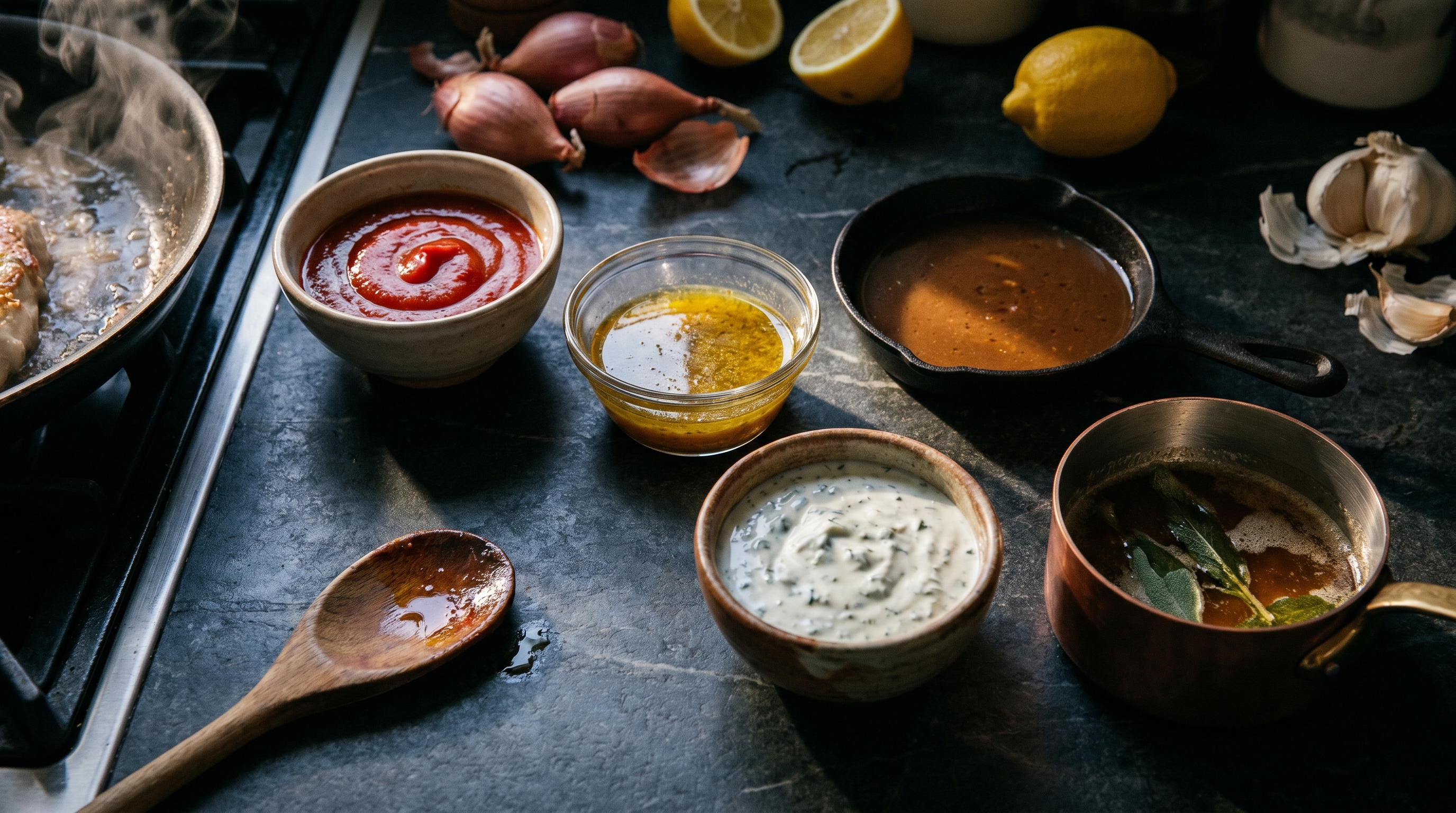
Sauce is not a finishing touch. Sauce is a witness protection program for mediocre cooking.
A good sauce can rescue dry meat, bully bland vegetables into having a personality, and make a bowl of rice feel like somebody out there still believes in you. If you know five of them—just five—you can stop panic-ordering takeout because your chicken looks emotionally unavailable.
This is not a classical French breakdown with twenty-seven mother sauces and a dead-eyed culinary instructor whispering about espagnole like it pays child support. This is real-life sauce doctrine for people standing in a kitchen at 6:43 p.m. holding a spoon like a flare gun.
These are the five sauces worth tattooing on your lizard brain.
Because dinner doesn't usually fail all at once.
It fails in little humiliations.
The potatoes are fine but boring. The salmon is cooked but needs help. The grain bowl tastes like a seminar on disappointment. Sauce is how you take a meal from “technically edible” to “get in here and eat this before I change my mind.”
1. Tomato Sauce: The Red Workhorse That Carries Half the Civilized World
Tomato sauce is not just for pasta. That’s like saying water is just for swimming.
A proper tomato sauce is the dependable friend who shows up with jumper cables, ibuprofen, and exactly the right amount of judgment. It can coat noodles, braise meatballs, poach eggs, back up beans, spoon over polenta, rescue stuffed peppers, hide a multitude of sins, and make weeknight food taste like someone’s aunt loves you aggressively.
Here’s the skeleton: olive oil, onion or garlic, canned whole tomatoes or crushed tomatoes, salt, maybe chili flakes, maybe basil, maybe butter if you want the edges sanded down. That’s it. Stop adding twelve random spices like you’re spinning a flavor wheel at a cursed carnival.
Cook the onion gently until soft.
Add garlic for 30 seconds, not until it turns bitter and tastes like a house fire.
Add tomatoes, crush them, salt it properly, and simmer until it tastes less like the inside of a can and more like an actual idea.
Want depth? A spoon of tomato paste fried in oil before the tomatoes go in.
Want roundness? A knob of butter at the end.
Want brightness? Finish with olive oil or a splash of red wine vinegar.
Tomato sauce teaches the first great sauce truth: reduction is flavor concentration, not kitchen punishment. Let water leave so the tomatoes can stop shouting and start singing.
And for the love of all holy carbohydrates, buy decent canned tomatoes. Not necessarily luxury tomatoes blessed by monks on a volcanic hillside. Just not the metallic sadness can that tastes like pennies and regret.
What it saves: pasta, meatballs, chicken cutlets, beans, eggs, roasted vegetables, baked fish, lasagna, your reputation.
2. Vinaigrette: The Tiny Riot That Wakes Up Dead Food
Vinaigrette is the most underrated sauce in America because people keep trapping it in salad.
That’s insane behavior.
Vinaigrette belongs on grilled vegetables, beans, lentils, chicken, fish, grain bowls, potatoes, sandwiches, and anything beige enough to need legal intervention. It is acid plus fat plus seasoning—the holy trinity of making food taste like it has a pulse.
The basic ratio is somewhere around 3 parts oil to 1 part acid, but ratios are guidance, not scripture carved into a mountaintop by a dehydrated chef. Sometimes you want it sharper. Sometimes softer. Taste it like an adult with free will.
Use olive oil, sherry vinegar, red wine vinegar, lemon juice, or cider vinegar.
Add Dijon mustard if you want body and emulsification.
Add minced shallot if you want the kind of elegance that says, “Yes, I do know where my peeler is.”
Salt it enough to matter.
Pepper it enough to flirt.
Then whisk until it comes together into something glossy and alive.
A good vinaigrette doesn’t just add flavor. It changes the geometry of the food. Rich things feel lighter. Starchy things feel sharper. Greens stop tasting like wet paperwork. A spoonful on hot roasted carrots is the difference between “fine” and “why am I suddenly emotional about carrots?”
Also: toss potatoes in vinaigrette while they’re warm. Warm potatoes drink dressing like sailors on shore leave. This is fact.
The second great sauce truth is this: acid is often the thing you think salt is missing. If your food tastes flat, it may not need more seasoning. It may need a slap of brightness.
3. Pan Sauce: The Fastest Way to Look Like You Know What the Hell You're Doing
Pan sauce is culinary fraud in the best possible way.
You sear chicken, pork chops, steak, salmon—whatever. You pull the protein out. The pan looks a little gnarly, covered in browned bits and rendered fat and what appears to be the aftermath of a delicious bar fight. Good. That mess is money.
That brown stuff is fond. Yes, fond. French for “don’t you dare wash this down the sink.”
Here’s the move: pour off excess fat if needed, leave a little behind, add shallot or garlic if you want, then hit the pan with wine, stock, vermouth, cider, or even water with a squeeze of lemon if times are hard. Scrape up the browned bits. Reduce.
Then finish with butter.
That’s the velvet jacket right there.
The butter emulsifies into the reduced liquid and turns it glossy, rich, and suspiciously restaurant-like. Add herbs. Add mustard. Add capers. Add black pepper. Add a splash of cream if you want to drive this convertible off a cliff into luxury.
But understand the structure: fat, aromatics, deglaze, reduce, mount with butter.
That structure will carry you through a thousand dinners.
And here’s where people screw it up. They either don’t brown the meat enough to create flavor, or they blast the sauce with too much liquid and end up with a sad puddle. You want concentration. You want intensity. You want the sauce to lightly coat the back of a spoon like it has secrets.
There’s something deeply satisfying about a pan sauce because it is made from the ghost of the thing you just cooked. It’s culinary reincarnation. Nothing wasted. Everything intensified.
Also, life lesson: the good stuff is usually stuck to the bottom after heat and pressure. Scrape gently and proceed.
4. Yogurt Sauce: Cold, Tangy, and Better Than Half the Condiments in Your Fridge
A yogurt sauce is what happens when freshness walks into a room full of heavy food and opens a window.
Greasy roasted meat? Yogurt sauce.
Spiced vegetables? Yogurt sauce.
Fritters, kebabs, grain bowls, charred broccoli, lamb, chicken, falafel, leftover meat shoved into a flatbread at midnight while you question your choices? Yogurt sauce.
Plain Greek yogurt is the base. From there: garlic, lemon juice, olive oil, salt. That alone is enough to make roast chicken sit up straighter.
But you can turn the dial.
Add grated cucumber and dill for something tzatziki-adjacent.
Add tahini for nuttiness and body.
Add mint, cilantro, scallions, or parsley depending on where dinner wants to go.
Add Aleppo pepper, cumin, sumac, or coriander if you’d like the whole thing to wink at you.
What makes yogurt sauce essential is contrast. Hot food loves cold sauce. Rich food loves tang. Crispy food loves creaminess. It’s edible balance, and balance is sexy as hell when done right.
Use full-fat yogurt if you can. Nonfat yogurt has the emotional texture of office lighting.
And don’t overdo the raw garlic unless you want your dinner guests to remember you by scent alone. Let it be assertive, not violent.
The third great sauce truth: temperature contrast matters. A cool sauce on a hot dish creates drama. You’re not just seasoning. You’re directing a scene.
5. Brown Butter Sauce: The Nutty Little Devil That Makes Everything Taste Expensive
Brown butter is regular butter after it’s seen some things.
You melt butter in a light-colored pan, and first it foams, then the milk solids start turning golden, then brown, and suddenly your kitchen smells like toasted hazelnuts, warm caramel, and decisions you absolutely should repeat. That is brown butter. It takes minutes. It feels illegal.
And yes, I know some people classify this as barely a sauce.
Those people are boring and probably refrigerate tomatoes.
Brown butter can be finished with lemon, capers, sage, vinegar, nuts, or a splash of pasta water. It can drape itself over ravioli, fish, cauliflower, green beans, gnocchi, roast squash, or fried eggs like a silk robe falling off a chaise lounge.
The point is not complexity.
The point is transformation.
Butter contains water, fat, and milk solids. When the water cooks off and the milk solids toast, you get flavor that tastes absurdly sophisticated for something you made while leaning on the stove in socks.
Watch it carefully. Brown butter has the life expectancy of a mayfly once it starts getting dark. There’s a thin line between nutty and “why does the kitchen smell like a toaster crematorium?” Pull it when it’s amber-brown and fragrant.
Add lemon juice off heat if you don’t want it spitting at you like an offended cat.
This sauce is especially good when food needs richness but not heaviness. It’s butter with cheekbones.
The Section Where We Go Off the Rails and Talk About Underwear Drawers
Your sauce situation is exactly like your underwear drawer.
Stay with me.
You do not need twenty-three specialty items for rare emotional occasions. You need a small core lineup that works under pressure, survives bad planning, and doesn’t make you feel ridiculous on a Tuesday.
Nobody needs six half-used bottled sauces breeding in the refrigerator door like a municipal science project. One teriyaki from 2022. A sticky sweet chili bottle with a crusted cap. Ranch. Mystery aioli. Something green and expired enough to have legal rights.
This is how kitchens become museums of false potential.
The fantasy self buys condiments.
The actual self needs systems.
Five core sauces teach you the mechanics behind nearly everything else: reduction, emulsification, acidity, fat, contrast, aromatics, texture. Once you understand these, you can improvise instead of obey. And that’s where cooking stops feeling like homework and starts feeling like seduction.
Because sauce is not just a recipe.
It’s a language.
Tomato says comfort.
Vinaigrette says wake up.
Pan sauce says trust the browning.
Yogurt says calm down, sweetheart.
Brown butter says we can be filthy little aristocrats for six minutes.
Look at that. We wandered into philosophy wearing an apron with stains on it.
How These Five Sauces Actually Run Your Entire Kitchen
If you learn these five, you learn the moves underneath the moves.
Tomato sauce teaches simmering and reduction.
Vinaigrette teaches balance and emulsification.
Pan sauce teaches deglazing and extracting flavor from fond.
Yogurt sauce teaches contrast and restraint.
Brown butter teaches attention—real attention, the kind most people only fake during meetings and first dates.
And suddenly dinner gets easier.
Chicken with pan sauce.
Roasted carrots with yogurt sauce.
Pasta with tomato sauce.
Green beans with brown butter and lemon.
Leftover grain bowl with mustard vinaigrette.
That’s not five sauces.
That’s a dozen meals and an exit strategy from blandness.
You don’t need to become the sort of maniac who labels squeeze bottles and ferments turnips in a studio apartment with no ventilation. You just need a few dependable moves and the courage to taste as you go.
That last part matters.
Taste the sauce before serving it.
Again, taste the damn sauce.
A sauce is not finished when the recipe says so. It’s finished when it tastes complete—salty enough, sharp enough, rich enough, alive enough. Recipes can point. Your mouth decides.
And maybe that’s why sauce matters more than people think.
It’s the part of cooking where you adjust.
Where you respond.
Where you admit that what’s in front of you might need tenderness, brightness, fat, heat, or a little more time.
That’s dinner, sure.
But it’s also half of being a person.
Learn five sauces. Feed people better. Panic less. Taste more.
The rest is garnish.