



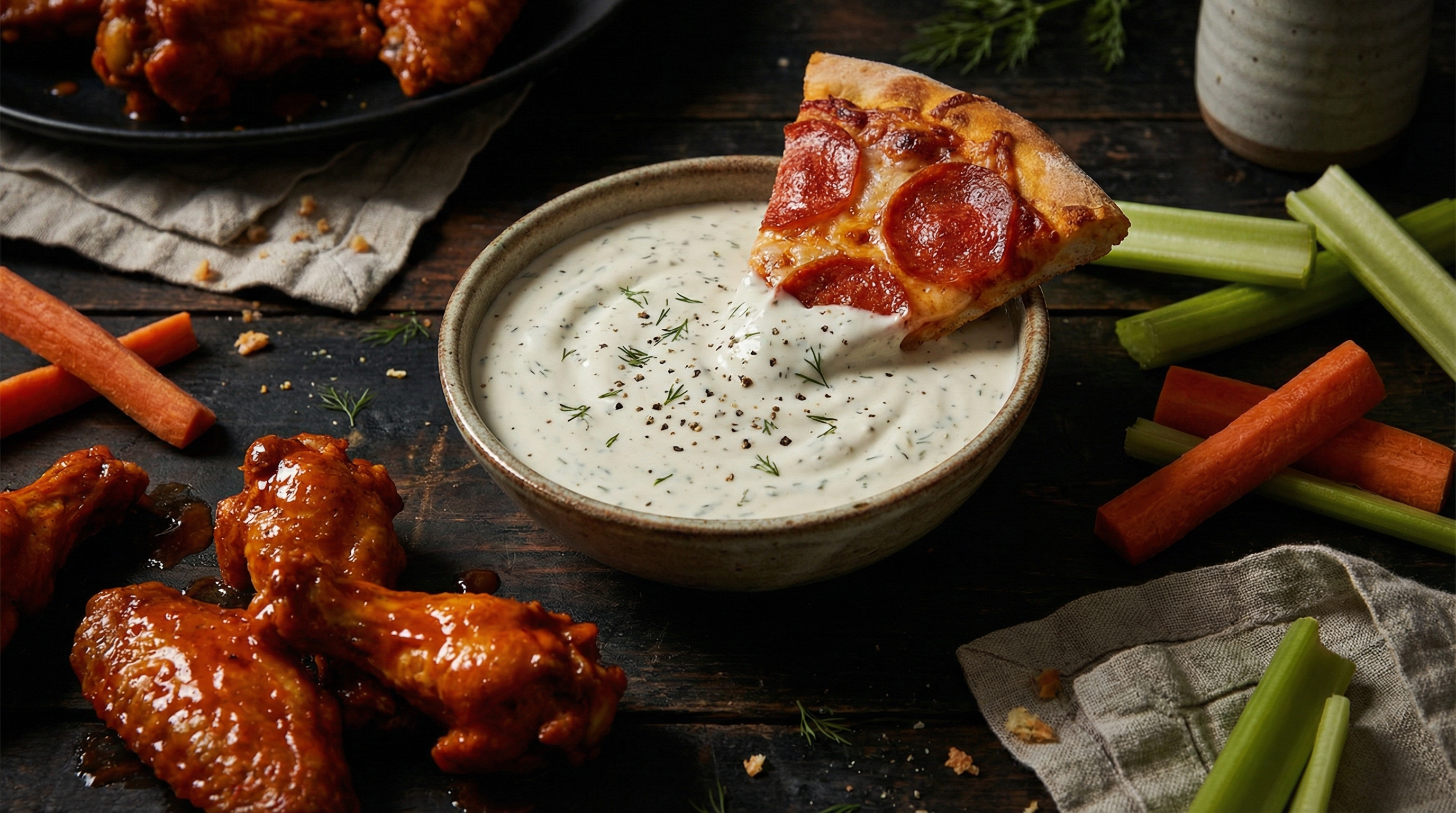
Ranch Dressing Is Not a Dressing. It Is a National Personality Test.
Let me say something brave and deeply stupid: ranch dressing is the most honest food in America.
Not the best. Not the noblest. Not the sexiest. Honest.
You put a bowl of ranch on the table and people reveal themselves like raccoons under a porch light. The disciplined pretend they're above it. The chaotic start dipping pizza crust in it before you've finished saying grace. The truly enlightened take one bite, squint, and go, "Whose ranch is this?" because they know not all white goo deserves reverence.
That's the whole game right there.
Ranch is either a cool, tangy buttermilk miracle laced with garlic, dill, black pepper, and enough onion to whisper sweet threats into your salad, or it's a sweet, gluey bottle of refrigerator sadness that tastes like mayonnaise got a job in middle management.
And people talk about it like it's one thing.
It is not one thing. "Ranch dressing" is a category so broad it might as well include weather, divorce, and all country songs written after 1997.
So is ranch an American treasure or a culinary war crime?
Yes.
The Original Sin: Most Ranch Is Bad Ranch
Listen. I don't care if you "love ranch." What you probably love is the idea of ranch.
The fantasy ranch. The ranch of memory. The cold cup next to hot wings in a sports bar where the television is screaming and someone named Tyler is having a spiritual event over overtime. That ranch, at its best, is divine. It cools the tongue. It rounds out heat. It drapes itself over a fried object like a mink coat on a bad decision.
But bottled supermarket ranch? A lot of it tastes like someone dissolved a scented candle in sour cream.
That's because good ranch lives and dies on freshness. Real ranch wants buttermilk with actual tang. Sour cream with body. Mayo that's there for silk, not domination. Fresh dill if you've got it. Dried dill if you don't, because we're cooking, not auditioning for a farmer's market cult. Garlic powder, onion powder, cracked black pepper, a little parsley, maybe chives, a pinch of MSG if you're not a coward, lemon juice if the buttermilk is sleepy.
Bad ranch tastes sweet for no reason.
Sweet ranch is an abomination. If your ranch tastes like it just got back from a day at the county fair, something has gone horribly wrong.
And here is the first important distinction, tattoo it on your soul: restaurant ranch and shelf-stable bottled ranch are barely related. One is a living creature. The other is a tax document.
Why America Fell Face-First Into the Dip Cup
Ranch did not become huge because Americans are idiots.
It became huge because ranch solves problems.
Dry carrot sticks? Ranch. Aggressively salty wings? Ranch. Sad cafeteria salad? Ranch. Pizza crusts too bleak to live? Ranch. Vegetables for people who still talk about vegetables like they're a disciplinary measure from childhood? Ranch.
Ranch is culinary diplomacy.
Acid from buttermilk. Fat from mayo and sour cream. Aromatics from garlic and onion. Herbs for freshness. Salt to wake the dead. That's not random. That's architecture. It's a creamy suspension bridge connecting bland food to pleasure.
People mock it because it's white and ubiquitous and sold in vats big enough to drown a dachshund. Fine. Mock away. But the flavor logic is airtight.
Creamy, tangy sauces exist everywhere because human beings are not complicated. We like food that feels good in the mouth and covers minor sins.
Aioli gets to wear a little black dress and say it's European. Tzatziki gets cucumber and yogurt and everyone acts like it reads books. Green goddess puts on a necklace of herbs and suddenly it's cultured. Ranch shows up in cargo shorts and people call the cops.
That's class warfare, baby.
The Ranch Spectrum: From Sacred to Sinister
Here is the part nobody wants to admit: ranch has terroir.
Yes, I said it. Sit down.
There is pizzeria ranch, which is sharper and thinner, built for crusts and grease. There is wing-joint ranch, cold as a morgue drawer and thick enough to cling to a drumette like it's afraid of abandonment. There is steakhouse ranch, usually hidden in the salad station pretending to be respectable. There is Midwest church-basement ranch, sweet Lord above, where miracles and mayonnaise shake hands under fluorescent lights.
And then there is homemade ranch.
Homemade ranch is what happens when you stop treating dressing like a condiment and start treating it like a sauce with self-respect. The key is balance. Too much mayo and you've made sandwich paste. Too much buttermilk and you've invented creamy regret. Not enough salt and the whole thing lies there like a damp sock.
A proper ratio to start? About 1/2 cup mayo, 1/2 cup sour cream, and 1/3 to 1/2 cup buttermilk, depending on whether you want dip or dressing. Add 1 teaspoon garlic powder, 1 teaspoon onion powder, 1 tablespoon chopped dill or 1 teaspoon dried dill, 1 tablespoon chopped chives, a tablespoon of parsley, a squeeze of lemon, plenty of black pepper, and enough salt to make the herbs stand up straight.
Then let it sit.
This is crucial. Freshly mixed ranch is like a band at soundcheck. Fine, but not transcendent. Give it 30 minutes in the fridge and suddenly everyone's in tune. Give it two hours and you've got harmony. Overnight? Dangerous. That's seduction in a jar.
The Pizza Question, Also Known as the Collapse of Civilization
Now we enter the blood feud.
Ranch with pizza.
Some people react to this like you proposed replacing the Statue of Liberty with a vape pen. They scream about tradition. They invoke Naples. They clutch pearls over pepperoni.
Relax, Giuseppe. Nobody is putting ranch on your grandmother's marinara with the good San Marzanos and buffalo mozzarella blessed by moonlight. We're talking about American delivery pizza, a glorious grease disc engineered to survive a car ride and a family argument.
And on that battlefield, ranch makes tactical sense.
Salty cheese, spicy meat, fatty crust, acidic tomato — ranch brings cooling dairy, herbal lift, and a soft landing for all that sodium. It's not always necessary. But neither is a leather jacket, and people still look fantastic in one.
That said, ranch should accompany pizza, not waterboard it.
A dip on the crust? Fine. A little swipe on a hot slice with jalapeños? Understandable. Flooding the entire pie until it looks like it was rescued from a dairy avalanche? Straight to jail.
Use restraint. Even pleasure needs boundaries. That's true in the kitchen and on vacation.
Off the Rails for a Moment: Ranch Is the Crocs of Sauces
Stay with me.
Crocs are ugly. Everybody knows this. They look like a boat sank into a clown shoe and then gave up. And yet people love them because they're comfortable, practical, washable, weirdly dependable, and impossible to kill.
That is ranch.
Ranch is not trying to be elegant. It does not care about your tasting menu. Ranch is standing in the doorway at 11:48 p.m. holding a vegetable tray and saying, "You hungry or do you want to keep performing sophistication for no reason?"
This is why ranch endures. Not because it's refined. Because it is useful. It is emotionally available. It meets mediocre food more than halfway. It turns raw broccoli from punishment into a vehicle. It makes cafeteria carrots feel like they were hugged.
America worships convenience with the grim devotion of an airport traveler buying almonds for fourteen dollars. Ranch fits that psyche perfectly. It asks nothing. It gives immediately. It has the golden retriever energy of condiments.
And yes, that very generosity is also what makes it dangerous.
Anything that can improve fries, chicken tenders, salad, onion rings, cold pizza, and a desperate celery stick becomes less a condiment than a lifestyle. That's when we lose the plot. That's how you end up with ranch fountain machines and ranch-flavored everything and a nation that briefly forgot herbs are supposed to taste like something besides nostalgia and stabilizers.
If You Want to Judge Ranch, Judge It Correctly
Do not judge ranch by the fluorescent bottle your cousin keeps in the fridge door next to expired pickle relish and three mustards nobody trusts.
Judge it cold.
Judge it freshly mixed.
Judge whether it tastes tangy first, savory second, herby third. Judge whether the garlic is present but not kicking down the walls. Judge whether the dill says hello without turning the whole thing into fish-counter cologne. Judge the texture. It should coat a lettuce leaf, not grout a bathroom tile.
And for the love of all that sizzles, dip a raw carrot in it. That's the lie detector test.
A good ranch makes a carrot taste like a snack. A bad ranch makes you think terrible thoughts about produce and the future of the republic.
Also: temperature matters. Warm ranch is unspeakable. Ranch should be cold enough to feel corrective. It's not a soup. If your ranch has been sitting out at a tailgate long enough to develop opinions, throw it away.
So... Treasure or War Crime?
Here's the verdict.
Ranch is an American treasure when it's made with intention, balance, and a little damn dignity. When it's fresh, tangy, herbal, peppery, and used like a smart accessory instead of a structural material, it absolutely rules. It belongs with wings, crudités, wedge salads, fried pickles, and yes, occasionally, a trashy-delicious slice of pizza that knows exactly what it is.
Ranch becomes a culinary war crime when it's sweet, stale, shelf-stable beyond comprehension, or deployed as a blanket to smother every food into identical creamy submission. If all your meals taste like ranch, you are not seasoning. You are hiding.
And maybe that's why this stupid sauce inspires such big feelings.
It's not really about ranch.
It's about standards. About convenience versus care. About whether a thing can be common and still be excellent. About whether pleasure has to be fancy to count.
Food does this all the time. It sneaks up and asks a bigger question while you're standing there with a carrot stick in one hand and your dignity in the other.
The truth is, some of the best things we eat are humble, ridiculous, and a little embarrassing. They come in ramekins. They drip down your wrist. They make snobs nervous. They remind you that joy does not always arrive wearing a tuxedo.
Sometimes joy is cold, white, flecked with dill, and waiting beside a basket of hot wings like an old friend who never judges you for showing up hungry.
That's not a war crime.
That's dinner.