

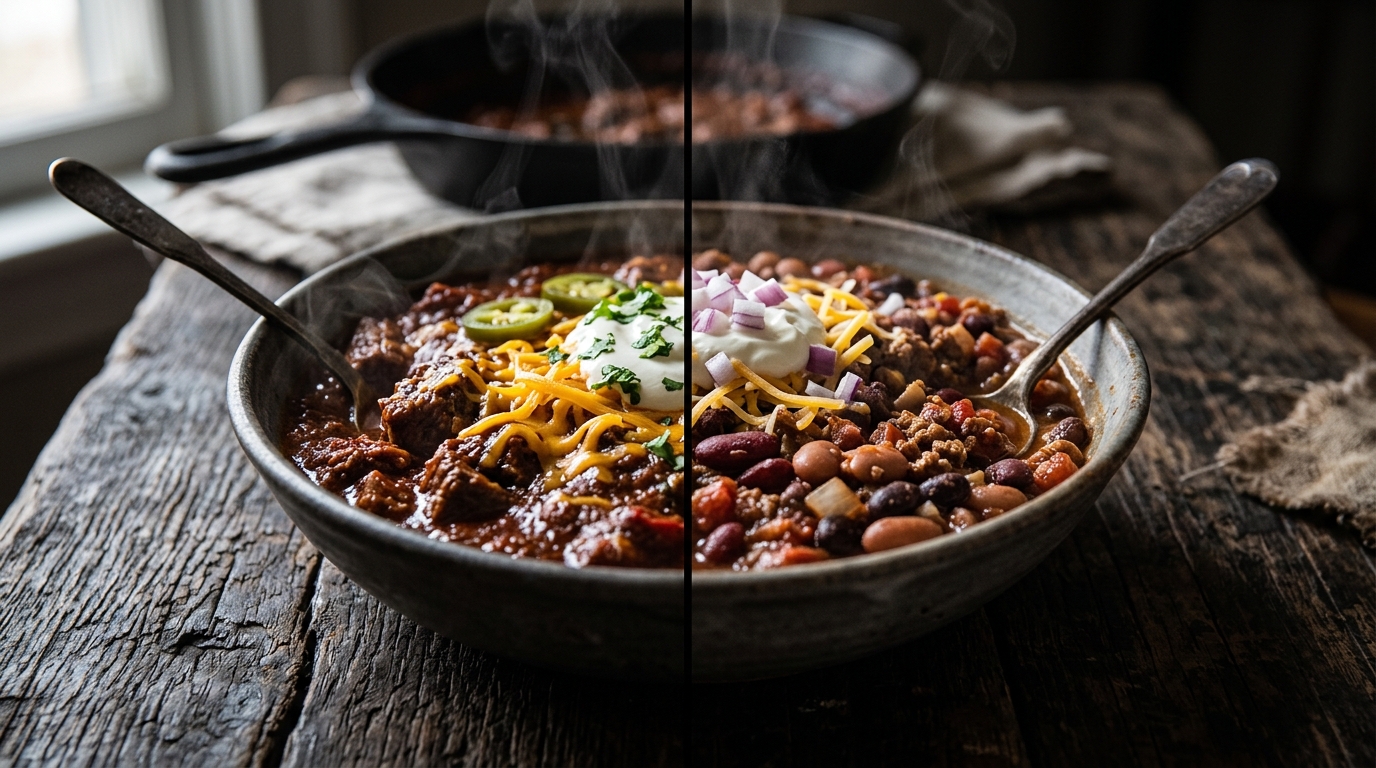
The beans-in-chili debate has raged longer than most marriages, and with about the same level of bitterness. Someone on the internet recently asked, "Who the hell decided beans belong in chili?" and I felt that in my sternum. Because beans in chili are freeloaders. They are the guy at the party who brought nothing but opinions and a acoustic guitar. They crash the meat party's red sauce rave and turn a thick, brooding hug from ground beef and tomato demons into a watery protest march of regret.
I have feelings about this. Buckle up.
The Real History of Chili (And Why Beans Are an Interloper)
Chili con carne — literally "peppers with meat" — was born in San Antonio in the mid-1800s. Not in a kitchen. Not in a restaurant. On the actual dirt, by women called "chili queens" who sold bowls of slow-simmered beef and dried chiles out of open-air stalls in Military Plaza. The dish likely traces back even further to the Canary Island immigrants who settled San Antonio in 1731, bringing spice-heavy stew traditions from the old country and adapting them to local dried peppers and tough range beef.
Notice what's missing from that origin story? Beans. Not a single legume. Nobody was tossing kidney beans into the pot because nobody had the audacity. The original chili was beef, dried chiles, wild oregano, cumin, and enough garlic to make your sweat smell like a warning. That was it. That was the whole religion.
Beans showed up later, like a cousin who hears about the party after it's already legendary. During the Depression, cooks stretched chili with beans and crackers because they had to — because feeding people on nothing was more important than culinary purity. That's a noble reason. But the Depression ended, Gerald. You can afford beef now. Put the pinto beans back in the cabinet where they belong.
Why Texas Chili Has No Beans (It's Not Stubbornness — It's Law)
Texas doesn't just prefer chili without beans. Texas codified it. The International Chili Society, founded in 1967 after the legendary Terlingua cookoff between humorist H. Allen Smith and Texas chili god Wick Fowler, has explicit competition rules: no beans, no pasta, no rice, no other vegetables. Traditional Red Chili at ICS sanctioned cookoffs is meat, chiles, spices, and your grandmother's disappointment. That's the ingredient list.
The Terlingua cookoff itself is a beautiful piece of American absurdity. Smith, a New York writer, published an article declaring he made the best chili in the world. Fowler, a Dallas journalist who literally sold chili seasoning kits, took personal offense. They met in an abandoned ghost town in the West Texas desert and cooked chili in front of hundreds of people. The judge declared it a draw because he "burned his tongue," which is the most Texas possible outcome of any competition.
But here's the thing most people get wrong about why Texas chili has no beans: it's not just tradition or machismo. It's about what the dish actually IS. Texas-style chili — also called "bowl of red" — is a chile pepper sauce with meat in it. The star is the chile. Dried ancho, guajillo, pasilla, maybe some de arbol for heat. You're building a complex, layered pepper flavor and then braising beef in it. Beans don't add to that. They absorb the sauce, mute the pepper complexity, and turn something that should coat your mouth like a velvet threat into a porridge.
That's not gatekeeping. That's understanding what the dish is trying to do.
The Midwest Ruined Everything (With Love)
Somewhere between Texas and Ohio, chili lost its mind.
Midwestern chili is a different animal entirely. It's more of a bean soup with ground beef seasoning than a chile pepper showcase, and honestly? In that context, beans make sense. If your chili starts with a can of tomato sauce, a packet of McCormick seasoning, and a pound of ground chuck from a tube, then sure — throw some kidney beans in there. You're not making chili con carne. You're making Tuesday night. And Tuesday night is allowed to have beans.
Cincinnati chili went even further off the rails. Macedonian immigrant Tom Kiradjieff started serving his cinnamon-and-chocolate-spiced meat sauce over spaghetti in 1922, and an entire city said "yes, this is chili now." You can get it "five-way" with meat sauce, spaghetti, beans, onions, and a mountain of shredded cheddar. It's technically delicious and categorically insane. It's also not chili. It's a fever dream that happens to contain ground beef.
I respect Cincinnati chili the way I respect someone who brings a trombone to a dinner party. I don't understand your choices, but I admire the commitment.
The Texture Argument (Where Bean People Get Desperate)
Bean defenders always retreat to texture. "Beans add a creamy contrast!" they say, eyes wide with the confidence of someone who has never eaten properly braised beef.
You know what adds texture to chili? MEAT. Cubed chuck that's been braised for three hours until it falls apart when you look at it wrong. Coarse-ground beef that still has some chew. A rich, thick sauce that reduced while you were doing something else with your life. That's texture. You don't need a kidney bean sitting in there like a little mealy speed bump on the way to flavor.
And the "protein" argument — don't even start. "Beans are a great source of protein." So is the BEEF. In your BEEF chili. You are not adding beans for nutrition. You are adding beans because your mother added beans, and her mother added beans, and nobody in your family had the spine to break the cycle. This is generational bean trauma, and it ends with me.
I will say this: if you're making a vegetarian chili, beans are not just acceptable — they're mandatory. They're the structural foundation of the whole operation. Black beans, pintos, cannellinis, whatever you've got. Load it up. A good vegetarian chili is a beautiful thing, and beans are doing all the heavy lifting that the absent beef left behind. That's not freeloading. That's stepping up.
But if there is beef in your pot, the beans need to wait outside.
The Only Chili Recipe That Matters
I'm not going to gatekeep without handing you the keys. Here's how you make real chili — no beans, no apologies, no packet seasoning that tastes like a parking lot.
Chef Snackhole's Bowl of Red:
- 3 lbs beef chuck, cut into 1/2-inch cubes (not ground — cubed, like an adult)
- 6 dried ancho chiles, stemmed and seeded
- 3 dried guajillo chiles, stemmed and seeded
- 2 dried chiles de arbol (or more, if your tongue has a death wish)
- 1 large yellow onion, diced
- 6 cloves garlic, minced
- 2 tbsp ground cumin
- 1 tbsp dried oregano (Mexican oregano if you can find it)
- 2 cups beef stock
- 2 tbsp tomato paste (not sauce — paste, for body)
- 2 tbsp neutral oil or rendered beef fat
- Salt, black pepper
- 1 bottle of beer you'd actually drink (nothing "lime-flavored," Derek)
- Toast the dried chiles in a dry skillet until fragrant and pliable, about 30 seconds per side. Don't burn them or they'll taste like revenge.
- Soak the toasted chiles in hot water for 20 minutes. Blend with 1 cup of the soaking liquid into a smooth paste.
- Season and brown the beef cubes in batches in a heavy pot. Don't crowd the pot. Crowding the pot is how you steam meat, and steamed beef is a cry for help.
- Remove beef. Cook onion and garlic until soft. Add cumin and oregano, cook 1 minute until your kitchen smells like a reason to live.
- Add the chile paste, tomato paste, beer, and beef stock. Return the beef. Stir.
- Bring to a boil, then drop to a low simmer. Cover and cook for 2.5 to 3 hours, stirring occasionally, until the beef is tender and the sauce is thick enough to make a spoon stand up and question its life choices.
- Season with salt and pepper. Serve with diced white onion, shredded cheddar, and a corn muffin if you're feeling generous.
That's chili. No beans. No filler. Just beef and peppers having the conversation they were always meant to have.
The Line in the Sand
I know some of you are already composing furious comments about your grandmother's bean chili recipe that won a ribbon at the county fair in 1987. I believe you. I believe it was delicious. I believe your grandmother was a wonderful person who loved you and also put beans in chili because she didn't know any better.
But here's the truth: if you have to add beans to make your chili good, your chili isn't good. Beans are a crutch. They're the laugh track on a sitcom that isn't funny enough on its own. They fill space. They add volume. They do not add soul.
Real chili is concentrated. It's aggressive. It grabs you by the collar and says "pay attention." It doesn't need filler. It doesn't need a supporting cast of legumes to prop up a weak sauce. It stands alone — a pot of red, simmered with patience, built from dried chiles and good beef and the kind of stubbornness that makes people start blogs about food.
This is the hill. I am on it. I brought my Dutch oven and I'm not leaving.
Chef's NoteChef's Verdict: Beans in chili are a participation trophy for people who are afraid of commitment. If your chili needs beans to be interesting, you don't have a chili problem — you have a flavor problem. Fix your chile paste. Brown your meat harder. Simmer longer. And for the love of everything holy, stop adding kidney beans to a dish that was perfect before you got involved. The bean goes in the burrito, Patricia. Not the chili.