


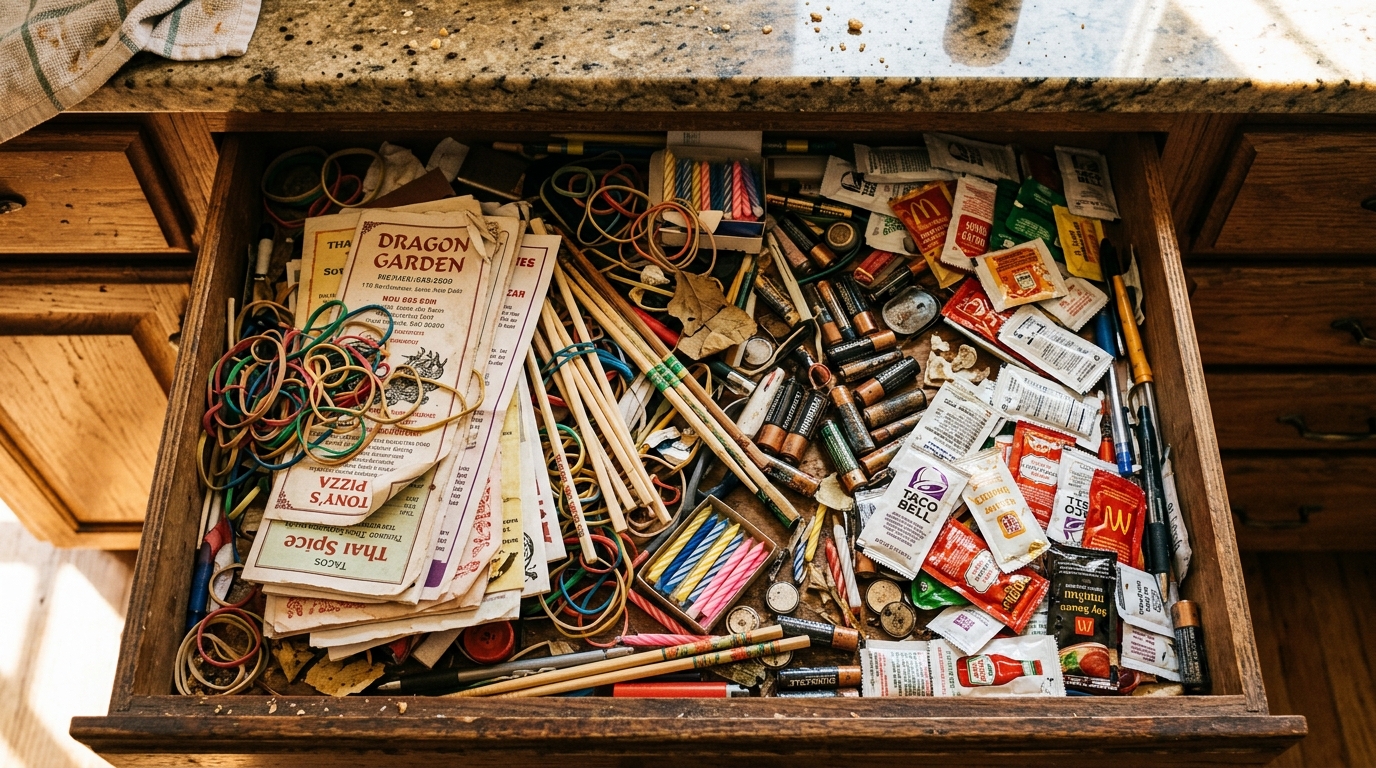
My kitchen junk drawer is where utensils go to disappear and soy sauce packets go to retire.
I opened mine last Tuesday looking for a rubber band. Came out ten minutes later holding a birthday candle, three chopsticks that aren't friends, and a takeout menu from a restaurant that closed during the Obama administration. There was a corn cob holder in there. One. Singular. I have never in my life purchased a corn cob holder. It materialized from the drawer dimension like a fossil from a civilization that believed in organized eating.
Every kitchen has one of these drawers. It starts as a reasonable overflow zone — a place for the extra twist ties and that one pen that works sometimes. Then it becomes a sedimentary record of every impulse buy, forgotten gadget, and condiment packet you were too guilty to throw away. Your junk drawer is not a drawer. It is an archaeological dig site. And buddy, the artifacts are damning.
The Five Geological Layers of Every Kitchen Junk Drawer
If you excavated your junk drawer with the care of a museum professional, you would find distinct strata. Each one tells a story. None of the stories are flattering.
Layer 1: The Surface (Last 3 Months) This is the stuff you actually interact with. A pen. Some chip clips. A lighter that works 60% of the time. Scissors that you put back even though they have dried tape residue on the blades. Batteries that might be dead. You will never test them. You will just try them in the remote and when they don't work you'll put them back in the drawer like a monster.
Layer 2: The Midfield (6-12 Months Ago) Twist ties that have mated and formed a copper nest. Soy sauce packets — at least fourteen. A meat thermometer you used once for Thanksgiving and then abandoned like a seasonal employee. Coupons that expired during a different season. A mystery key that opens nothing in your current home and possibly nothing on this planet.
Layer 3: The Sediment (1-3 Years) Instruction manuals for appliances you can see from where you're standing. An avocado slicer that worked worse than a regular knife but cost $11.99 so it earned drawer immortality. Birthday candles — always birthday candles — in colors that don't match any cake you remember. A garlic press with dried garlic cement in the holes. You will not clean it. You will not throw it away. It will outlive you.
Layer 4: The Fossil Record (3-7 Years) That takeout menu. A phone charger for a phone you no longer own. Rubber bands that have fused into a single amber-colored disc. A wine stopper from a bottle you opened in 2019 and finished in 2019 because nobody in history has ever re-corked wine and meant it. A packet of silica gel that says DO NOT EAT which means at some point someone ate one and ruined it for the rest of us.
Layer 5: Bedrock (Origin Unknown) The corn cob holder. A single wooden skewer. A small plastic thing that might be part of a blender or might be a chess piece — you will never know and you will never throw it away. Allen wrenches from IKEA furniture you assembled in a previous apartment. They are yours now. They are everyone's now. The Allen wrench is the cockroach of the hardware world.
The Psychology of Why You Keep This Stuff (It's Not Laziness, It's Grief)
Let me be real with you for a second. You are not keeping 23 soy sauce packets because you think you'll need them. You are keeping them because throwing them away feels like admitting you ordered too much takeout. That junk drawer is an emotional support system disguised as a storage solution.
Psychologists call this the endowment effect — the tendency to overvalue things simply because you own them. That avocado slicer cost you twelve bucks and forty seconds of Amazon optimism. Throwing it away means admitting the purchase was a mistake, and your ego would rather keep a useless piece of plastic in a dark drawer than process that micro-grief.
There's also the just-in-case fallacy. You keep the mystery key because what if one day you find the lock? You keep the dead batteries because what if they're not dead? You keep the takeout menu because what if that restaurant reopens and you need to know their spring roll prices from 2016?
They won't. They're dead. It won't.
But I get it. I truly do. The junk drawer is the one place in your kitchen where perfection isn't expected. Your countertops have to look nice. Your fridge has to be stocked. But the junk drawer? That's your kitchen's diary. It's where you're allowed to be chaotic. And honestly, there's something beautiful about that — in the same way there's something beautiful about a raccoon eating pizza on a fire escape.
The 5-Category Purge System (That Actually Works)
Alright, enough poetry about your garbage. Let's fix this. I'm going to give you a system that takes about twenty minutes, requires zero trips to The Container Store, and will make you feel like you just lost five emotional pounds.
Dump the entire drawer onto your counter. All of it. Let the horrors see daylight. Now sort everything into five piles:
1. DAILY TOOLS (The Keepers) Scissors, tape, one pen that works, chip clips, rubber bands (three — not thirty), a working lighter or matches, and twist ties (five max). These are your first-string players. They go back in the drawer. Everything else has to earn its spot.
2. UTENSIL REFUGEES (Rehome or Release) That meat thermometer, the garlic press, the lone corn cob holder, the avocado slicer, the melon baller you used as an ice cream scoop once. Here's the test: have you used it in the last six months? If yes, it doesn't belong in the junk drawer — it belongs in your utensil crock or a dedicated tool drawer. If no, it goes in the donation pile or the trash. The avocado slicer goes in the trash. I'm not asking.
3. CONDIMENT GRAVEYARD (Toss All of It) Every soy sauce packet. Every ketchup packet. Every Taco Bell hot sauce you're "saving." Every single one. I know this hurts. I know you think you're being thrifty. You are not. You are hoarding sodium. If you use soy sauce regularly, you own a bottle. If you don't, fourteen packets won't change that. Into the trash. All of it. Grieve and move on.
4. PAPER AND MYSTERY ITEMS (The Shredder Pile) Expired coupons, old takeout menus, instruction manuals (they're all online now, I promise), business cards from people you don't remember, and receipts so faded they look like they were printed on a ghost. Recycle the paper. For mystery items — keys, plastic parts, unidentified metal bits — put them in a small bag. If you don't identify their purpose within 30 days, they leave your home forever.
5. BATTERIES AND TECH DEBRIS (Test or Trash) Dead batteries, old phone chargers, earbuds with one working side, USB cables for devices that no longer exist. Test every battery right now. Working ones go in a small container. Dead ones go to your local battery recycling drop-off, which exists at basically every hardware store. That phone charger for your 2017 Samsung? Donate it or recycle it. It is not coming back.
Cheap Organizer Solutions That Don't Require a Personality Change
You do not need a $45 bamboo drawer organizer from a company that uses the word "curated" in their product description. You need compartments. That's it. Here's what actually works:
- Small cardboard boxes you already own. Cut down cereal boxes, tea boxes, or check boxes to drawer height. Tape the edges. Congratulations, you have custom dividers that cost nothing and are replaceable when they get gross.
- A silicone muffin tin. Twelve little compartments, non-slip, washable, and about six bucks at any store. Perfect for batteries, rubber bands, twist ties, and other small chaos.
- Ice cube trays. Same principle, smaller compartments. Great for pushpins, birthday candles (the two you're allowed to keep), and small hardware.
- Tension rods. Two small tension rods placed widthwise across the drawer create three sections instantly. No glue, no screws, two dollars.
- Mason jar lids. The flat disc part, not the ring. Lay them in the drawer as little corrals for items that roll. Pens, markers, that one thermometer.
The goal is not Instagram perfection. The goal is being able to open the drawer, find the scissors, and close it again without triggering a small avalanche of soy sauce and regret. That's the bar. It is not a high bar.
The Utensils You Actually Need vs. The Ones Taking Up Space
While we're in there, let's talk about the utensil refugees. Because half the reason your junk drawer is stuffed is that your utensil storage is full of things you never use, so the things you DO use end up homeless.
Here's what you actually need in your kitchen, total, assuming you cook at home a few times a week:
- A chef's knife (8-inch, the only knife that matters)
- A paring knife
- A serrated bread knife
- Wooden spoon
- Silicone spatula
- Metal tongs (the spring-loaded kind, not the salad tongs your aunt gave you)
- A fish spatula (works on everything, not just fish — it's the greatest lie in kitchen nomenclature)
- Ladle
- Whisk
- Vegetable peeler
- Can opener
- Meat thermometer (instant-read, not the one with the cord)
- Microplane grater
- Cutting board (one large, one small)
That's it. Fourteen things. If you have a utensil crock with 30 items jammed in it, at least half of them are tourists. The garlic press? Use the side of your knife. The avocado slicer? Use literally any knife. The egg separator? Use your hands, you Edwardian nightmare. The banana slicer? I'm calling the police.
Every unnecessary utensil in your crock pushes a necessary one into the junk drawer. It's utensil gentrification. The tongs get displaced by a novelty corn stripper and end up living between a dead battery and a 2018 Bed Bath & Beyond coupon. This is how kitchen drawers die.
The Quarterly Purge (A Maintenance Plan for Chaotic People)
Here is the truth about junk drawers: they will refill. You are not going to become a different person. You are still going to save one soy sauce packet "just in case." You are still going to put the mystery key back. This is human nature and I'm not here to fix your soul.
But every three months — pick a day, put it in your phone, I don't care if it's the first day of each season or your dog's half-birthday — dump the drawer and do the five-pile sort again. Twenty minutes. Four times a year. That's eighty minutes of annual maintenance to prevent your kitchen from developing a geological record.
And here's the trick that keeps it manageable: the One In, One Out rule. Every time you toss a new takeout menu, mystery object, or impulse-buy gadget into the drawer, something else has to leave. It doesn't matter what. Just grab the oldest-looking thing and throw it away. You won't miss it. You haven't missed anything that's ever left that drawer. Not once. Not ever.
Chef's NoteThe Verdict: Your kitchen junk drawer is not a moral failing. It is an inevitability. Every kitchen in every home in every country has one, and they all contain the same dead batteries, mystery keys, and condiment packets from restaurants that no longer exist. The difference between a functional junk drawer and a crime scene is twenty minutes and the willingness to admit that you are never going to use that avocado slicer. Dump it out. Sort five piles. Use cereal boxes as dividers. Do it again in three months. Your drawer will still be a junk drawer — it'll just be a junk drawer that knows its boundaries. And honestly? That's more than most people can say about themselves.