


Fusion food is not a crime. It’s a refrigerator with ambition.
The panic around “fusion food” is one of the dumbest little operas in modern eating.
A guy will happily dip a french fry in Japanese mayo while drinking Italian espresso after a burrito and then suddenly turn into the Vatican if somebody serves him gochujang mac and cheese. Relax, Lorenzo. Your lunch is already a United Nations fever dream.
The phrase itself is suspicious. “Fusion food.” Sounds like a startup founded by a man named Brent who wears loafers without socks and says things like “disrupting flavor.” But the thing underneath the stupid label? Normal. Ancient. Human as hell.
Cultures have been borrowing, stealing, flirting, trading, conquering, fleeing, adapting, and smashing ingredients together since the first person looked at a foreign spice and said, “I bet that would slap on this goat.” That’s the whole story of food. That’s dinner.
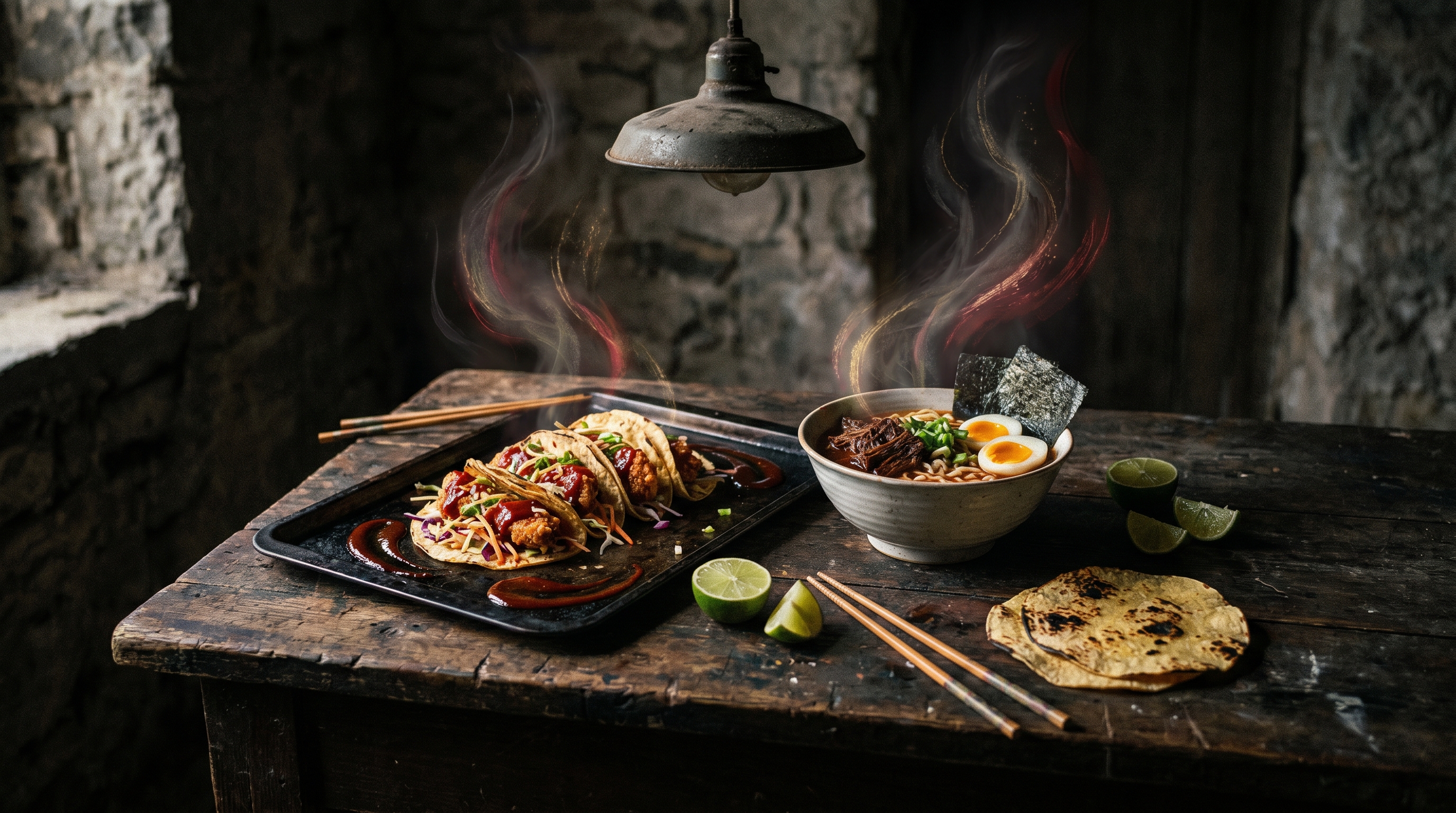
And yet every few months some plate hits the internet — butter chicken pizza, sushi burrito, miso carbonara, birria ramen — and people react like someone has vandalized the moon.
They haven’t.
They just seasoned something with more than one passport.
Your “traditional” favorite is probably a historical accident with good PR
Let’s pop the hood on this authenticity tantrum.
A shocking amount of what people call “traditional” is just old fusion that survived long enough to become respectable. Tomatoes came from the Americas. Chilies took a world tour and changed entire cuisines. Potatoes crossed oceans and became national identity in places where they were once foreign weirdos sitting on the dock like suspicious lumps.
Imagine being the first person in Italy to see a tomato.
A red alien blob from another continent. Wet. Slightly obscene. Looking like it had secrets.
Now imagine some mustached purist at the time screaming, “This is not authentic Roman peasant food!” and getting ignored by history because the sauce tasted incredible. That’s usually how food works. The loudest person in the room is often just the future’s footnote.
Even dishes people treat like sacred tablets came from movement: migration, empire, trade routes, necessity, substitution, leftovers, colonization, poverty, abundance, weather, lust, laziness. Food is not a museum display under glass. It’s a living, greasy little animal.
If you want to honor tradition, great. Learn it properly. Cook it with respect. Understand the technique, the context, the why.
But if you think tradition means freezing cuisine in amber forever, congratulations: you don’t love food. You love cosplay.
The real issue isn’t fusion. It’s whether the cook knows what the hell they’re doing
Here’s where I become tender for exactly six seconds.
Not all fusion is good.
There. I said it. Some of it tastes like a committee meeting in an airport lounge. Some chef somewhere has absolutely served a wasabi-truffle-mango aioli to a defenseless public, and that person should be sentenced to peeling shallots until they learn humility.
But that’s not because fusion is bad.
It’s because bad cooking is bad cooking, no matter what flag is on the menu.
A great fusion dish has a point of view. It understands structure. It knows whether it’s borrowing acid, heat, fat, texture, fermentation, smoke, sweetness, or starch from another tradition — and why.
That “why” matters.
Kimchi on a grilled cheese works because fermented funk and chile cut through rich dairy like a switchblade through cheap curtains. Miso in caramel works because salty, savory depth makes sweetness feel adult and dangerous. Tikka masala pizza works because charred bread, spiced tomato cream, melted cheese, and roasted meat were basically making horny eye contact across the room already.
Technique first. Chaos second.
If you’re combining cuisines, you need one stable anchor. Maybe it’s the format: taco, dumpling, noodle bowl, pizza. Maybe it’s the flavor architecture: bright-acidic-herbal, rich-spicy-creamy, smoky-sweet-hot. Maybe it’s one dominant technique — grilling, braising, frying, fermenting.
Otherwise you get culinary fan fiction. And not the good kind.
Stop confusing “authentic” with “familiar”
This is where people get especially ridiculous.
A lot of authenticity discourse is just disguised personal insecurity. People say “that’s not authentic” when what they really mean is “I have not seen this before and it is making my little brain itch.” That’s not moral clarity. That’s emotional support snobbery.
Now, yes, authenticity can mean something real.
It can mean cultural lineage. Technique passed down with care. Dishes tied to place, ritual, and memory. That matters. Deeply. A grandmother rolling dumplings by hand is not the same thing as a food truck putting bulgogi in a quesadilla at 1:14 a.m. after a concert. Both can be good. They are not the same experience.
But this is the important part, so put down your pitchfork and pick up a napkin:
Different is not disrespect.
Not automatically.
A Thai curry made by someone who understands balance — coconut richness, chile heat, fish sauce salinity, lime brightness, aromatic herbs — deserves respect on its own terms. A Thai-inspired curry pot pie might also deserve respect if the cook actually understands both curry and pie, instead of just hurling lemongrass into beige gravy and calling it innovation.
The issue is not cross-cultural cooking.
The issue is whether someone bothered to learn before they started freelancing with cumin.
A brief detour into tacos, because everyone loses their mind about tacos
The taco has become the internet’s favorite border checkpoint.
Put anything in a tortilla and suddenly six men with podcast microphones emerge from the fog to discuss legitimacy. Brother, it is a folded vehicle for deliciousness. Calm your chest.
Yes, tacos have histories. Regional identities. Indigenous roots. Working-class brilliance. They deserve more respect than being treated like edible cargo shorts for random fillings.
But also: tortillas are one of humanity’s greatest delivery systems. Of course people are going to put things in them. That is what happens when an object is useful.
You know what else works in a tortilla? Scrambled eggs. Leftover roast chicken. Crispy fish. Paneer with charred onions. Korean short rib. Falafel. Beans that have been cooked with enough onion and garlic to make the neighbors forgive your parking.
A tortilla does not wake up offended.
It wakes up ready.
The off-rails section: your pantry is already a crime scene
Let’s stop pretending your kitchen is some pristine embassy of culinary purity.
Open your pantry right now.
Go on. I’ll wait.
You’ve got soy sauce next to pasta. Hot sauce from Mexico, Dijon from France, peanut butter from an American childhood, maybe coconut milk from Thailand or the Philippines, maybe za’atar, maybe sriracha, maybe a box of supermarket couscous you bought during a week when you briefly believed you were becoming the sort of person who “uses preserved lemon.”
Your freezer has dumplings and waffle fries living side by side like a low-budget buddy comedy.
Your condiments are a shipwreck.
And that’s beautiful.
Because a home kitchen is not a constitutional monarchy. It is a raccoon with a debit card. It is adaptation. Improvisation. Tuesday.
You make a rice bowl with leftover salmon, kewpie mayo, pickled onions, and a sad avocado, and suddenly you’re not a cultural criminal — you’re a person trying not to waste food before it starts growing fur and opinions.
This is how cooking actually lives in the real world.
Not as doctrine.
As appetite plus circumstance.
If you want to make fusion food that doesn’t suck, do these actual things
Now we get useful, because I care about you despite everything.
First: learn one parent before you invent the child.
If you want to make, say, a Vietnamese-ish meatball sub with Italian-American energy, understand what makes each side tick. Learn how fish sauce works. Learn why pickled carrot and daikon matter. Learn what good meatballs need: proper salt, breadcrumbs or panade, maybe grated onion, gentle mixing, actual browning. Don’t just throw cilantro at a hoagie and call yourself Marco Polo.
Second: don’t stack strong flavors like a drunk building patio furniture.
Pick two stars and let everybody else be supporting cast. If you’ve got kimchi and gochujang, maybe skip the truffle oil. If your curry is fragrant with cardamom, cinnamon, clove, and fenugreek, maybe don’t also bring smoked gouda into the room unless you really know how to drive.
Third: balance the fundamentals.
Every successful dish, fusion or otherwise, is negotiating fat, acid, salt, heat, sweetness, bitterness, and texture. This is not mystical. This is your tongue begging for competent management.
Too rich? Add acid.
Too flat? Salt, probably. It’s almost always salt. Salt until the food wakes up and starts returning your calls.
Too muddy? You need freshness — herbs, citrus, raw onion, something with a pulse.
Too aggressive? Add fat or starch to spread the elbows out.
Fourth: respect names.
If your dish is inspired by something but not trying to be that exact thing, say so. “Inspired by.” “With the flavors of.” “A riff on.” This is not weakness. This is accuracy, and accuracy is sexy.
Fifth: test your joke before serving it to people.
Not every idea deserves a plate.
Sometimes the brain says “pho grilled cheese” and the mouth says “actually, yes.” Sometimes the brain says “sushi lasagna” and the mouth files a restraining order. Trust the second bite, not the first thought.
The class thing nobody wants to mention
A lot of food snobbery is just class anxiety wearing a linen apron.
When rich restaurants remix cuisines, it gets called boundary-pushing. When regular people do it at home or in neighborhood strip-mall joints, suddenly everybody becomes a scholar of purity.
Funny how that works.
A chef can charge $34 for tamarind-glazed pork belly over polenta with crispy shallots and get a magazine profile. But let a family-run place sell Korean fried chicken tacos and some clown online starts talking about “the sanctity of culinary tradition” between bites of a supermarket Caesar wrap.
Please.
Food has always moved with workers, immigrants, street vendors, aunties, hustlers, sailors, students, and people making dinner from what was available. Fusion is not some new corruption of the noble table. It is often the most honest expression of how people actually live.
It says: this is where I came from, this is where I am, and this is what was on sale.
That’s not confusion.
That’s autobiography.
So what should we actually protect?
Not purity. Purity is for lab samples and cults.
Protect credit.
Protect context.
Protect the people and communities who built the dishes everybody suddenly wants to monetize after mocking them for decades. If you borrow, say where it came from. Learn whose hands made the path easy for you. Pay people. Hire people. Listen to people. Don’t “discover” what your city’s immigrant neighborhoods have been cooking flawlessly since before you learned to pronounce aioli.
And for the love of all that sizzles, protect flavor.
Because the final judge is still the plate.
Does it taste good?
Does it make sense?
Does each part help the others become more themselves?
That last one matters more than people think. Great fusion doesn’t erase origins. It lets them flirt. It creates a third thing with both parents visible in the face.
That’s not dilution.
That’s creation.
Final bite: food is a language with an open border
People eat to remember, to survive, to celebrate, to improvise, to mourn, to show off, to seduce, to stretch rent, to feel less alone.
Of course the food changes when people do.
Of course flavors travel.
Of course a dumpling can fall in love with a chili crisp from somewhere else and make your whole miserable Wednesday better.
So no, fusion food is not fake food.
It’s just food behaving like people always have: moving, mixing, adapting, stealing a little, sharing a little, making something new out of whatever the world dragged into the kitchen.
And when it’s done well — when the acid snaps, the fat purrs, the heat lingers, the starch holds it all like a good friend — it reminds you of something obvious and strangely comforting.
We were never meant to stay separate on the plate.