

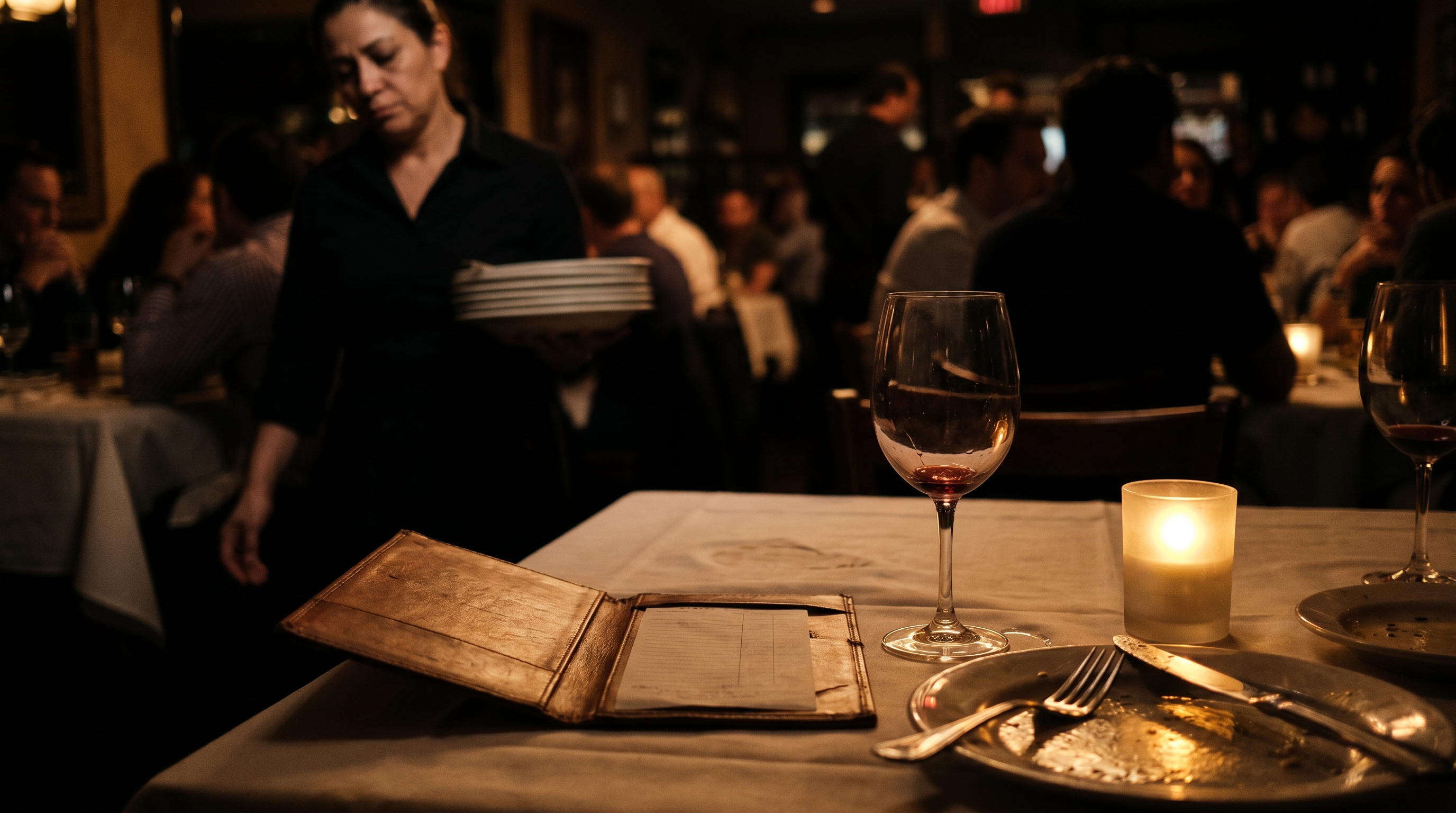
Tipping isn't generosity. It's a ransom note printed on the bottom of your receipt.
You sit down for pasta and a beer, and suddenly you're doing payroll math with a fork in your hand like a sweaty little accountant in a candlelit cave. It is deranged. It is inefficient. It is one of the dumbest social systems still shambling around in public wearing a necktie.
And you should still tip.
There. That's the whole ugly meatball. The system is broken in a way that would embarrass a carnival game, but the person bringing your fries did not build the carnival. Refusing to tip because "the employer should pay them" is morally elegant in the same way refusing to wear shoes in a parking lot is elegant. The principle may be sound. Your feet are still getting shredded.
Tipping Is a Side Quest Nobody Asked For
Let's not pretend this is normal.
You order a sandwich. Someone brings it to you. The restaurant has already decided what the sandwich costs. Then at the very end, they slide over a little digital guilt tablet asking whether you'd like to add 18%, 20%, or "prove you were raised by wolves." That is not pricing. That is emotional ambush with rounded corners.
And now tipping has escaped the restaurant and gone feral.
You buy a bottled water at an airport kiosk. Tip screen. Someone hands you a muffin they did not bake, on a counter you are standing next to, in a building owned by seven corporations and a ghost. Tip screen. A man rotates an iPad toward you with the solemn expression of a surgeon delivering bad news. Tip screen.
This is how civilizations decline. Not with fire. With preset percentages.
The rage people feel about tipping culture is real because it mixes three things humans hate: math, shame, and the suspicion that they're being manipulated by a touchscreen. It's the social equivalent of being trapped in a revolving door with a motivational speaker.
But here's the knife twist: the worker on the other end of that stupid tablet probably hates it too.
The Person in Front of You Is Not the Policy
Listen carefully, because this is where people start doing Olympic-level mental gymnastics to avoid spending four extra dollars.
Your server is not "the system." Your bartender is not corporate America wearing an apron. Your delivery driver is not the architect of late-stage capitalism balancing pad thai on a Honda Civic.
They're just the poor bastard trying to survive Tuesday.
And service work is not easy. Anyone who thinks it is has never carried four waters, split a check for nine idiots, smiled through a man's twenty-minute speech about "real tequila," and then sprinted to the kitchen because table twelve says the aioli feels "aggressive." Aggressive aioli. We used to build railroads.
A decent server is doing triage, theater, logistics, memory work, emotional regulation, and cardio. Simultaneously. In non-slip shoes that cost too much and smell like fryer grief.
A bartender is running a chemistry lab for sad accountants and first dates.
A delivery driver is gambling with traffic, weather, apartment buzzers, broken elevators, and the possibility that your porch light is apparently a decorative rumor.
These people are not extras in your dinner movie. They are the suspension bridge holding up your little night out.
If the bridge is paid in tips, and you know that going in, not tipping because you resent the bridge's funding structure does not make you principled. It makes you the kind of person who watches a waiter refill your Diet Coke three times and then says, "I just don't support tipping culture," like you're Che Guevara of the Cheesecake Factory.
Yes, The System Is Historically Rotten
Let's say the quiet part out loud: tipping in America has roots in class snobbery and exploitative labor practices. It has been used for ages as a convenient way for businesses to underpay workers while pretending customers are participating in some noble ritual of merit-based gratitude.
Merit-based gratitude is nonsense, by the way.
Sometimes the service is slow because the kitchen is on fire in a spiritual sense. Sometimes your server looks distracted because her kid is sick. Sometimes the bartender forgot your second lager because six people just ordered mojitos at once, which should frankly put them on a watchlist.
The point is not that every service interaction is perfect. The point is that wages should not hinge on whether strangers are feeling magnanimous after appetizer number two.
It's absurd.
A civilized system would price food honestly and pay workers enough that a bad table didn't wreck their rent money. Menu prices would reflect labor like they reflect fish, flour, and the suspiciously expensive little ramekin of burrata. Owners would own the whole cost of doing business instead of outsourcing payroll to your conscience.
That would be better.
That would be cleaner.
That would also not help your server tonight.
"But If We All Stop Tipping, They'll Have to Change" Is Fantasy Football for Cheap People
No, they won't.
Or rather: not on a timeline that protects the people currently working. Systems do not collapse neatly because you made a point over wings. They lurch. They drag. They crush the wrong people first.
The fantasy goes like this: enough customers stop tipping, workers revolt, owners reform, angels sing, somebody finally explains the QR code menu. Beautiful. Cinematic. Smells faintly of justice and rosemary.
Reality is uglier.
The server just makes less money.
The bartender just eats the loss.
The driver just spends an hour bringing you Thai food for the wage equivalent of a haunted cough.
Owners, meanwhile, often keep owner-ing. Like raccoons in a storm drain, they are difficult to remove and weirdly resilient.
If you want structural change, support restaurants that use service charges or no-tip models and actually pay staff well. Vote for labor protections. Back minimum wage increases. Stop worshipping artificially cheap dining as if a $14 burger delivered by a human being should somehow arrive detached from labor costs.
But while we're trapped in the current sewage canal, you still tip the gondolier.
The Off-the-Rails Section: Grocery Stores, Babysitters, and Other Invisible Labor Miracles
You know what else people undervalue? Janitors. Childcare. School cafeteria workers. The person stocking yogurt at 5:30 a.m. while the rest of society is drooling into a pillow.
Civilization is held together by people doing repetitive, inconvenient, bodily work that richer people prefer to ignore until it stops happening. Then suddenly everyone notices. Funny, that.
When the trash isn't collected, the illusion dies in twelve hours.
When nobody cleans public bathrooms, we descend into medieval thinking by lunchtime.
When restaurants are short-staffed, customers act like explorers abandoned on a mountain because their ranch took nine extra minutes.
This is the connection. Tipping culture is one ugly branch of a much bigger tree: we are spectacularly bad at valuing the labor that makes comfort possible. We love the performance of convenience. We hate paying what convenience actually costs.
You want hot food, cold drinks, clean forks, quick delivery, substitutions, smiles, split checks, allergy accommodations, extra napkins, and a little birthday candle for your cousin Trevor, who is thirty-eight and still insists on a wish. Fine. But that fantasy is built on human effort.
Labor is not a special effect.
So How Much Should You Tip Without Becoming a Spreadsheet Goblin?
Don't make this harder than it is.
At a sit-down restaurant in the U.S., 20% is the standard if service was normal-to-good. Not transcendent. Not violin music. Just competent, decent, human. If somebody took care of you and didn't spit gin into your lap, 20% is not heroic. It's the fare.
If service was truly awful because the server was openly rude, absent, or negligent, you can tip less. But be honest with yourself. Was it actually bad service, or did your fries take too long because the whole place was slammed and you think hunger turns you into Napoleon?
For bars, a dollar or two per drink is fine for simple stuff, more for cocktails that involve actual craft and ten bottles doing acrobatics.
For delivery, tip like you understand that another person used their time, gas, and sanity to bring dumplings to your door while you remained pants-optional.
And if you're too broke to tip, I say this with love and only a little venom: you may be too broke for full-service dining right now. That is not a moral failure. I've been broke. Broke is educational in all the worst ways. But "I can afford the meal, just not the labor attached to the meal" is a fairy tale adults need to retire.
The Real Villain Is the Lie of the Cheap Meal
This is what it comes down to.
People don't just hate tipping because it's awkward. They hate it because it exposes the scam: the menu price was never the whole price.
Restaurants, delivery apps, and all manner of food businesses have trained us to expect convenience at a number that often only works if somebody else quietly absorbs the pain. Maybe it's the worker through low wages. Maybe it's the farmer. Maybe it's the dishwasher. Maybe it's the cook slicing shallots under fluorescent despair for less than your streaming subscriptions.
The tip line makes the hidden labor briefly visible, and that irritates people because now the moral bill arrives with the mozzarella sticks.
But visibility is not the same as injustice.
The injustice is the system that keeps labor hidden until checkout.
Your tip is not fixing that. It's just refusing to make the nearest worker pay for your awakening.
Tip Anyway, Then Stay Mad
That's the posture.
Tip anyway. Stay mad.
Tip the server because they live in the world as it is, not the world as your political theory wishes it were. Tip the bartender because your little old fashioned didn't stir itself. Tip the driver because rain exists and apartment buildings are designed by sadists.
And then aim your fury where it belongs: at business models built on underpaying workers and calling the difference "custom." At lawmakers who let wage loopholes slither on. At consumers who demand luxury-level convenience at flea market prices and then act shocked when there is social friction at the point of sale.
You can believe tipping culture is broken and still refuse to punish the people trapped inside it. In fact, that's the only position that isn't made of plywood and ego.
Food has always been more than food. A restaurant is a little machine for turning labor into comfort, chaos into pleasure, ingredients into memory. When it works, it feels effortless, which is exactly why people forget the humans in it.
Don't.
The meal lands in front of you hot, fragrant, glistening, impossible. Someone carried it through the storm. Until the system grows a spine, tip the person with the plate.