


Let me be absolutely clear about something before we begin: I am not here to yell at you.
I am here to prosecute you.
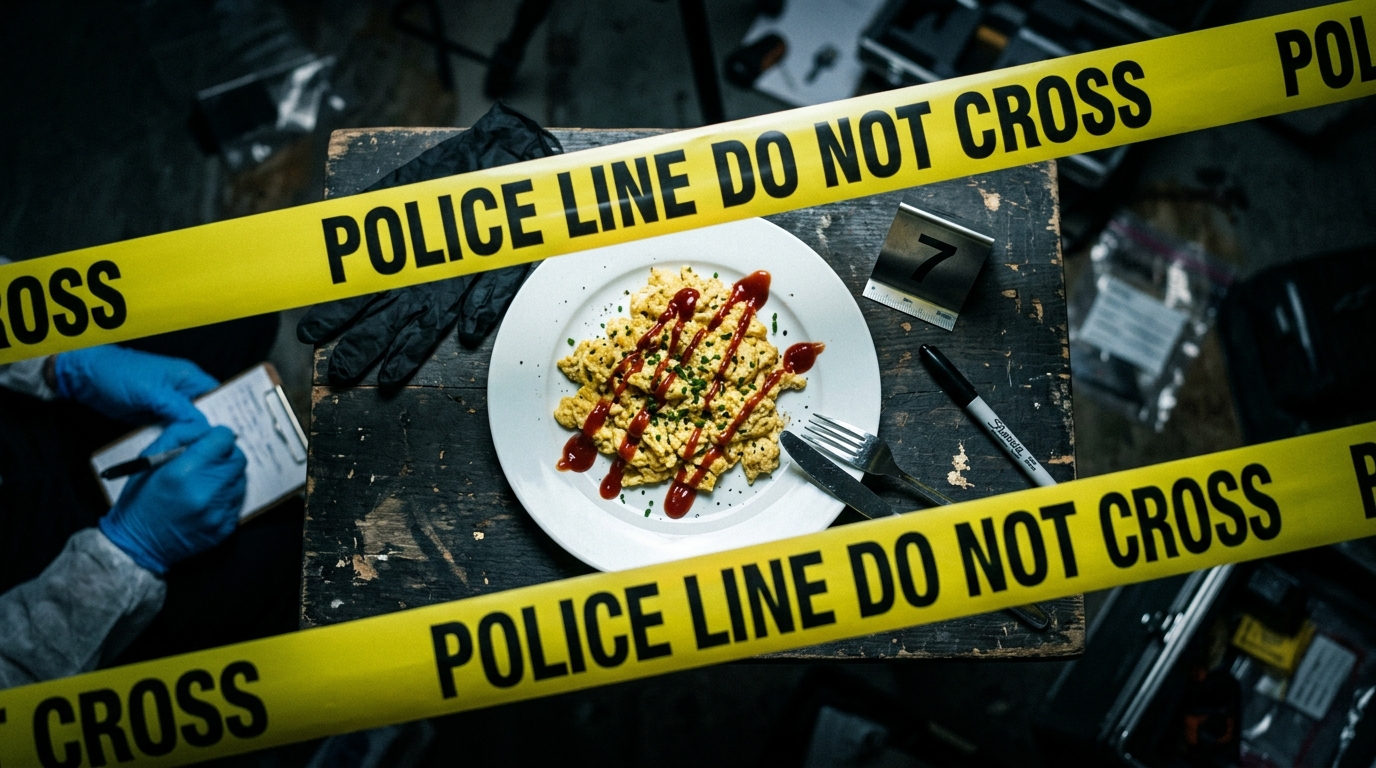
If you have ever picked up a bottle of Heinz, pointed it at a plate of scrambled eggs, and squeezed — you are a person of interest in an ongoing culinary investigation. Do not leave the kitchen. Do not contact your attorney. And for the love of everything holy, put down the ketchup.
The Crime Scene
Picture it. A Saturday morning. Butter in the pan. Eggs scrambled low and slow, the way God and Jacques Pepin intended — soft curds, barely set, glistening like they're about to be photographed for a magazine cover. You have created something beautiful. Something delicate. Something that took actual patience, which for most of you is already a personal record.
And then you grab a bottle of corn-syrup-sweetened tomato paste and hose it down like you're pressure-washing a driveway.
The eggs didn't ask for this. The eggs were perfect. You just couldn't leave well enough alone, could you? You looked at culinary grace and said, "This needs to be wetter and redder," like some kind of breakfast-destroying supervillain.
Every diner in America has witnessed this crime. The evidence is smeared across every plate bus tub from Tucson to Tallahassee.
A Brief and Disturbing History of Ketchup
Here's where it gets weird — and I mean historically, documentably weird.
Ketchup did not start as a tomato product. Not even close. The word "ketchup" (or ke-tsiap) traces back to 17th-century China and Southeast Asia, where it referred to a fermented fish sauce. Think fish sauce. Think anchovy brine. Think the liquid that collects at the bottom of a tin of sardines if you left it in the sun and then aged it on purpose.
British traders brought the concept back to England in the 1700s, where it evolved into mushroom ketchup, walnut ketchup, and eventually — because the British will put anything in a bottle if you dare them — tomato ketchup. The first tomato-based recipes showed up around 1812, but they were vinegary, spiced, and thin. Nothing like the sugar-loaded squeeze bottle sitting in your fridge right now.
Modern American ketchup is basically a dessert sauce wearing a savory costume. Heinz ketchup contains 4 grams of sugar per tablespoon. That is more sugar than some cookies. You are putting cookie sauce on your eggs and calling it breakfast. I want you to sit with that.
So when someone says, "Ketchup on eggs is traditional," what they're actually invoking is the ghost of a fermented fish condiment from the Fujian province. Which, ironically, would taste significantly better on eggs than what they're actually using.
Why Your Brain Craves It (The Science of Being Wrong)
I'm not going to pretend there isn't a reason people do this. There is. It's just not a good reason.
Here's the deal: eggs are rich in umami — that deep, savory fifth taste that makes things like parmesan, soy sauce, and mushrooms taste like the meaning of life. Eggs are loaded with glutamates, especially when you cook them right. Your tongue registers this and sends a signal to your brain that says, "This is good. But what if it were more?"
Ketchup hits the sweet-sour-umami trifecta. Tomatoes are naturally high in glutamic acid (umami). The vinegar adds acid. And then Heinz dumps in a truckload of high-fructose corn syrup because apparently umami wasn't enough — your eggs also needed to taste like they're going to prom.
So yes, neurologically, the combination "works." Your brain registers the sweet-savory contrast and releases a little dopamine hit. Congratulations. You know what else releases dopamine? Slot machines. That doesn't mean they're good decisions.
The problem isn't that the flavor combination is scientifically nonsensical. The problem is that ketchup bulldozes everything else on the plate. It's a one-note wrecking ball. The moment it touches your eggs, every other flavor — the butter, the salt, the pepper, the actual taste of the egg itself — gets buried under a landslide of sweet tomato goo. It's like hiring a jazz quartet and then letting someone play the trombone through a megaphone.
What You Should Actually Be Putting on Your Eggs
If your eggs need a condiment — and sometimes they do, I'm not a monster — then at least reach for something that enhances rather than erases. Here is a ranked list from a man who has made approximately forty thousand eggs and has strong opinions about every single one:
Tier 1: The Obviously Correct Choices
- Hot sauce (Cholula, Tapatio, Crystal) — vinegar-forward, pepper heat, doesn't drown the egg
- Salsa verde — tomatillo acidity with roasted chile depth, this is what eggs dream about
- Freshly cracked black pepper + flaky salt — revolutionary concept: season your food properly and it doesn't need a sauce
- Chili crisp (Lao Gan Ma or Fly By Jing) — crunchy, spicy, savory, and it makes you look like you know what you're doing
Tier 2: The Interesting Choices
- Gochujang — fermented Korean chile paste, sweet and spicy but with actual complexity
- Furikake — Japanese rice seasoning with sesame, nori, bonito; sounds weird on eggs, tastes like enlightenment
- Harissa — North African chile paste that makes your eggs taste like they've traveled
- Good olive oil + za'atar — pour it on, sprinkle the herbs, pretend you're eating breakfast in Tel Aviv
- Pickled jalape\xc3\xb1os — the vinegar brine does what ketchup wishes it could
Tier 3: The Underrated Choices
- Soy sauce + sesame oil — a few drops of each on scrambled eggs will rearrange your entire personality
- Calabrian chili paste — sweet heat with depth, the Italian hot sauce nobody talks about enough
- Fish sauce — two drops. TWO. And suddenly your eggs taste like they were cooked by someone who cares about them
- Nutritional yeast — hear me out. Nutty, cheesy, vaguely unhinged. Perfect for eggs.
Tier 4: Ketchup
- Listed here so you know I didn't forget it. I didn't forget it. I am choosing to rank it below nutritional yeast, and I need you to understand what that means.
The Hot Sauce Hierarchy (Since You Asked)
Let's settle this while we're here, because the "hot sauce vs. ketchup on eggs" debate is the actual war that matters.
Not all hot sauces are created equal on eggs. Some are transcendent. Some are performing a hate crime on your soft curds. Here's the breakdown:
S-Tier: Cholula. The balanced queen. Vinegar, arbol and piquin peppers, gentle heat, doesn't try to murder you. Cholula on scrambled eggs is the reason mornings exist.
A-Tier: Crystal. Louisiana-style, butter-friendly, cayenne-forward. Crystal on eggs with buttered toast is the most complete breakfast experience available to humans. Fight me.
A-Tier: Tapatio. West Coast ride-or-die. Slightly thicker, more garlic presence. The hot sauce that gas station breakfast burritos pray for.
B-Tier: Frank's RedHot. Perfectly fine. The Honda Civic of hot sauces. Reliable, everywhere, never exciting.
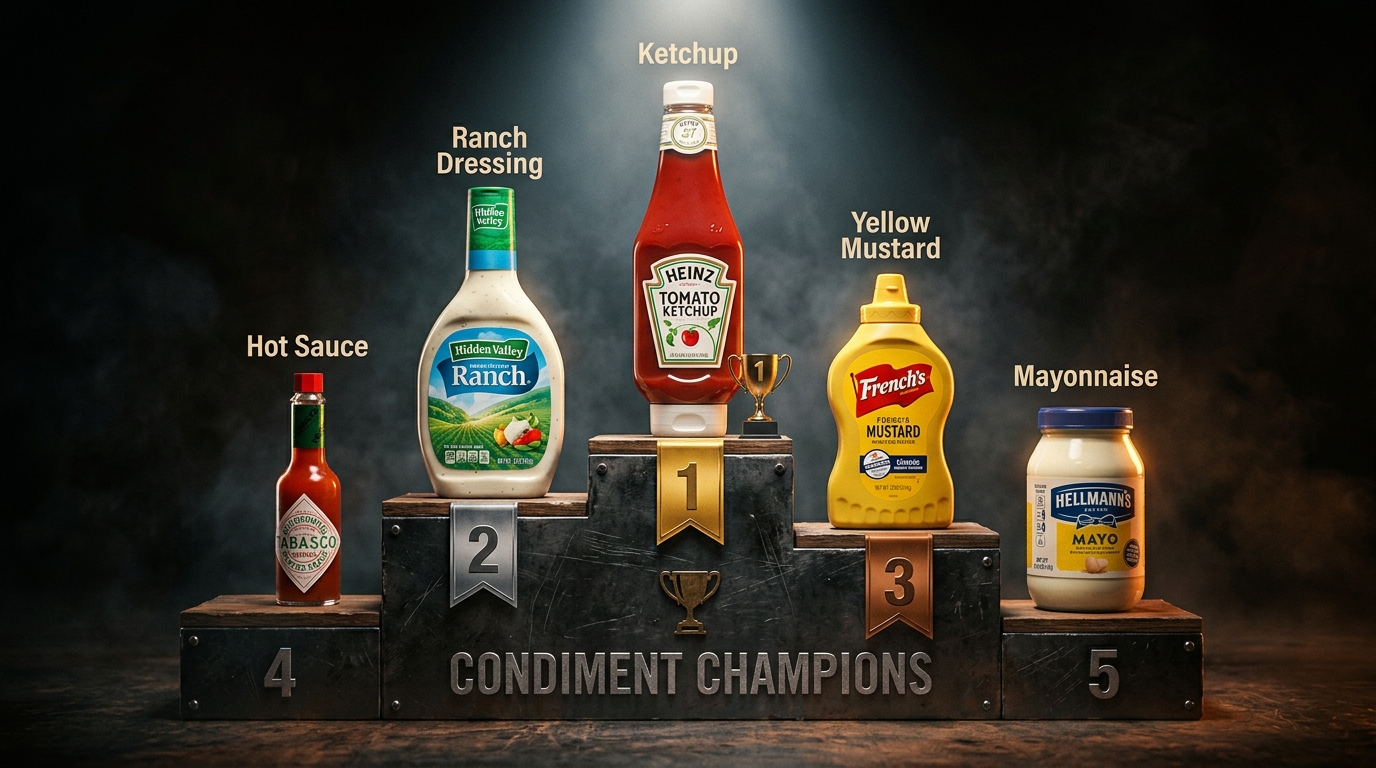
C-Tier: Tabasco. Too thin, too vinegary, slides right off the egg like it's late for a meeting. Tabasco is for Bloody Marys and oysters. It has no business on a plate of scrambled eggs.
D-Tier: Sriracha. I said what I said. Sriracha is too sweet and too thick for eggs. It's ketchup in a rooster costume. You're not fooling anyone. It's fine on pho. Leave it there.
The Verdict
Look. I know what you want me to say. You want me to say "everyone's palate is different" and "there are no wrong answers in food" and "let people enjoy things."
Absolutely not.
There are wrong answers. Ketchup on properly cooked eggs is one of them. Not because the flavor combination is impossible — we've established that your brain has reasons — but because it's lazy. It's the culinary equivalent of putting a bumper sticker over a scratch on a Ferrari. You are covering up good work with corn syrup because you never learned that eggs have a flavor worth tasting.
If your eggs are so bland that they need ketchup, the eggs aren't the problem. Your cooking is the problem. More butter. Lower heat. Pull them off the burner before they're done. Season them like you mean it. And then — if you must add something — reach for literally anything else on that list above.
Chef's NoteChef's Verdict: Ketchup on eggs is not a crime against flavor. It's a crime against potential. Your eggs could be extraordinary. Your eggs could make you weep with their simplicity and grace. Instead, you're drowning them in sugar sauce because you have the palate of a frightened child at a diner. I don't hate you. But I am deeply, profoundly disappointed. And if that sounds like your father — good. Maybe he should have taught you how to season food.
Now go make some eggs. Properly. And put the ketchup back in the fridge where it belongs — next to the other condiments you use as a crutch because you never learned to cook with confidence.
I believe in you. Barely. But I do.