


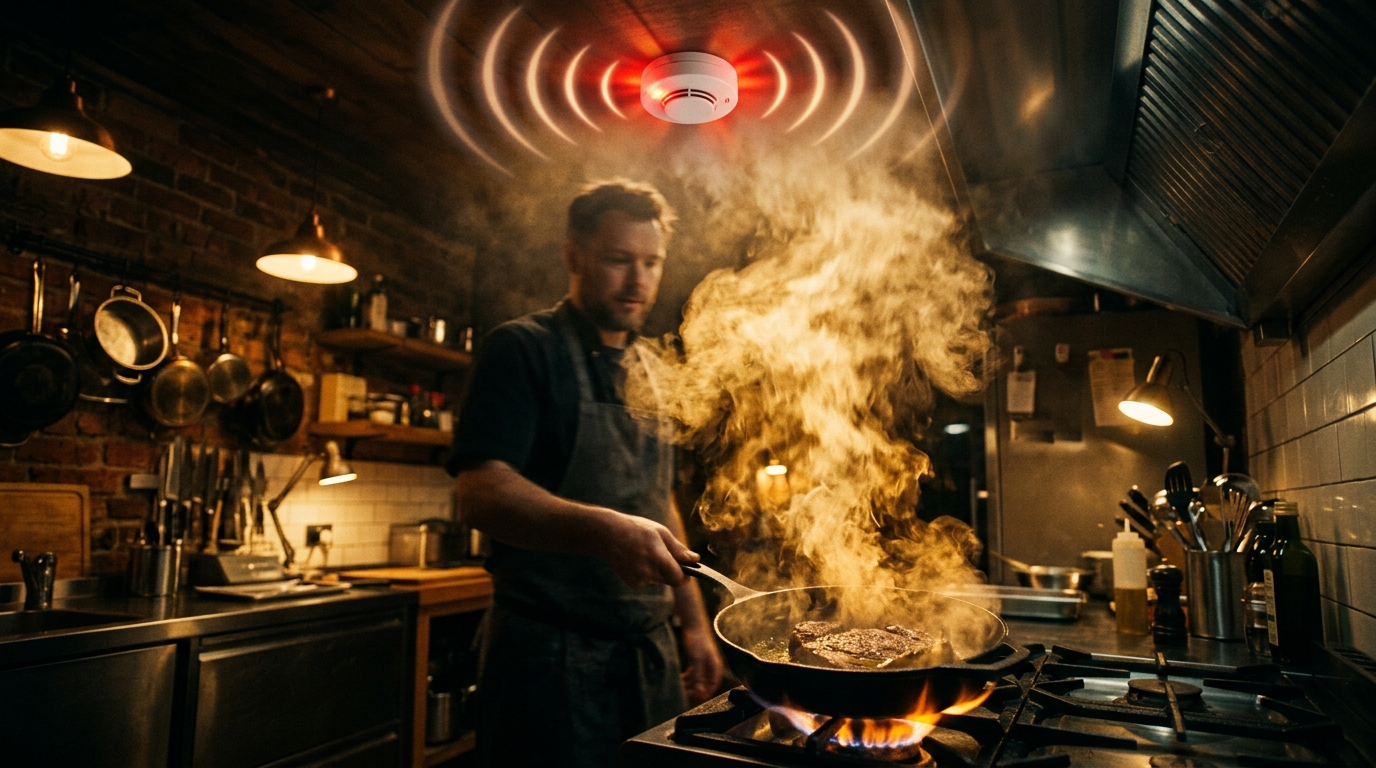
Has anyone noticed the smoke alarm only goes off when you're doing your best cooking?
Toast? Silent. Frozen nuggets? Nothing. But the second you get a skillet ripping hot like a responsible adult trying to put color on a piece of meat, that little frisbee on the ceiling starts screaming like you lit the curtains on purpose.
And then everybody in the house becomes a fire marshal. "What are you making?" DINNER, Brenda. I'm making dinner. Sorry the salmon needed heat and not a gentle spa treatment.
The Science of Why This Happens
Here's the thing — your smoke alarm isn't broken. It's actually doing its job too well. Most residential smoke detectors are ionization-based, which means they detect tiny particles in the air. The same particles that appear when you're properly searing a steak at 500°F.
The smoke from a hot skillet isn't the same as house-fire smoke. It's mostly vaporized cooking oil and the Maillard reaction doing its beautiful, beautiful work. But your alarm doesn't know the difference between "pan-seared perfection" and "the kitchen is on fire." It just knows: particles. Scream.
Why It Never Goes Off for Bad Cooking
Here's the cruel irony. The alarm stays dead silent when you're:
- Microwaving a sad desk lunch
- Boiling pasta into submission
- Reheating pizza at a temperature that couldn't warm a thought
- Making anything beige and lifeless
Because none of those activities generate enough heat to create smoke particles. You're essentially cooking at temperatures that wouldn't alarm a thermometer, let alone a smoke detector. The alarm only screams when you cook with actual fire energy.
The Dish Towel Helicopter
Also, why is the smoke alarm never just loud? Why is it spiritually loud? That beep goes through drywall, bone, memory. You could be three rooms away whisking a pan sauce and suddenly you're on a chair waving a dish towel at the ceiling like you're trying to communicate with a helicopter.
And it's always positioned directly above the stove. Who designed this? Who said "let's put the screaming device directly above the thing that makes smoke"? That's like putting a car alarm on a treadmill.
What You Can Actually Do About It
Before you rip the battery out (don't do that, I'm not your insurance adjuster):
- Get a photoelectric detector instead of ionization. They're better at telling the difference between cooking smoke and actual fire smoke.
- Use your range hood. If you have one and you're not turning it on before you sear, you deserve the alarm.
- Open a window. Revolutionary technology, available since houses were invented.
- Move the detector. If it's directly above your stove, it should be at least 10 feet away or in the next room.
- Embrace the chaos. The alarm is proof you're cooking at real temperatures. Microwaved chicken never set off anything except deep disappointment.
Chef's NoteThe smoke alarm is not your enemy. Bland, heatless cooking is your enemy. The alarm is just the messenger — and the messenger has the lung capacity of a stadium horn powered by anxiety.
Keep cooking hot. Keep waving that dish towel. And for the love of seasoning, turn on the damn vent.