

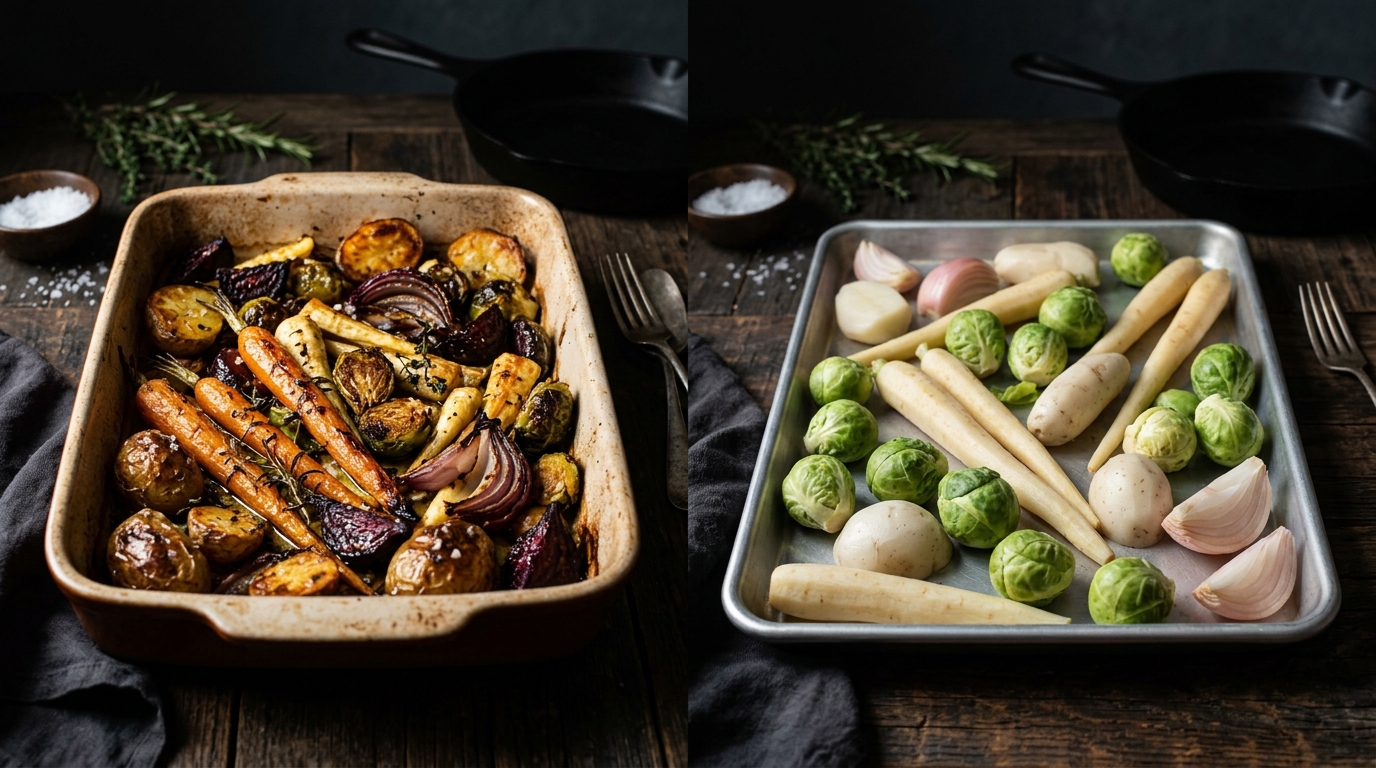
If you like your vegetables "with a little crunch," I need specifics. Because there's grilled asparagus with some backbone, and then there's broccoli that eats like packing peanuts. There's a difference between al dente and "this carrot still has hopes and dreams."
I'm not anti-crunch. I'm anti-laziness disguised as preference. And I'm here to walk you through the science of why your roasted vegetables taste like lightly warmed yard clippings — and how to actually fix it.
The Al Dente Lie: When "Crisp-Tender" Becomes "Basically Raw"
Somewhere along the way, home cooks decided that vegetables should be cooked just enough to change temperature but not enough to change personality. Like the vegetable equivalent of going to therapy once and calling yourself healed.
Here's the thing: al dente is a real technique — for pasta. When you apply it to a chunk of butternut squash, you're not being refined. You're serving someone a root vegetable that could still be replanted.
Properly cooked vegetables should yield to the bite without fighting back. A roasted carrot should be sweet and caramelized, not squeaking against your teeth like a dog toy in witness protection. Green beans should have a snap, not a crunch. There is a universe of texture between "mush" and "still photosynthesizing," and you need to find it.
The real tell? Taste. Raw and undercooked vegetables taste vegetal, bitter, and starchy. Properly cooked vegetables taste sweet. That's because heat breaks down cell walls and converts complex starches into simple sugars. If your broccoli doesn't taste noticeably sweeter than it did raw, it isn't done. Science said that, not me. Well, I said it too. Loudly.
The Maillard Reaction: Your Vegetables Deserve a Tan
You know that gorgeous golden-brown crust on a seared steak? That's the Maillard reaction — a chemical reaction between amino acids and reducing sugars that occurs above 280°F (140°C). It creates hundreds of flavor compounds that don't exist in the raw ingredient.
Guess what? It works on vegetables too. Those charred edges on properly roasted Brussels sprouts? Maillard. The deep mahogany on roasted cauliflower florets? Maillard. The caramelized tips of asparagus spears? You guessed it — Maillard, baby.
But here's where most people blow it: you cannot get the Maillard reaction if your vegetables are wet, crowded, or cooked at timid temperatures. You get steaming. And steamed vegetables from a sheet pan are the culinary equivalent of showing up to a party and standing in the corner holding your own coat.
The Maillard reaction needs:
- High heat: 425-450°F (220-230°C). Not 350°F. Not "medium." Crank it.
- Dry surfaces: Pat your vegetables dry. Oil them lightly. Moisture is the enemy of browning.
- Direct contact with the hot pan: That means a single layer. No stacking. No piling. Every piece needs its own personal relationship with the sheet pan.
If your vegetables come out of the oven looking the same color they went in, you haven't roasted them. You've given them a warm bath.
The Crowded Pan: A Crime Against Caramelization
This is the single most common vegetable crime in American kitchens, and I will not rest until it stops.
When you pile vegetables onto a sheet pan like you're loading a moving truck, you trap moisture between them. That moisture turns to steam. Steam keeps the surface temperature at 212°F — well below the 280°F+ needed for browning. Your vegetables are now boiling in their own sweat in a 425°F oven, which is both a waste of energy and a personal insult to the oven.
The rule is simple: one layer, space between pieces, no touching. If you have more vegetables than one pan can handle, use two pans. This is not the time for efficiency. This is the time for every single piece of broccoli to get its moment in the spotlight.
Here's the math, since apparently we need math to roast a vegetable:
- Standard half-sheet pan (18x13 inches): holds about 1 to 1.5 pounds of cut vegetables in a single layer
- Two pounds of Brussels sprouts? That's two pans. Period.
- Mixed vegetables? Cut them to similar sizes so they cook at the same rate, or stagger your additions
And for the love of all that is crispy — don't line the pan with parchment paper if you want maximum browning. Parchment insulates. Direct metal-to-vegetable contact gives you the best sear. Lightly oil the pan instead. Yes, you'll have to wash it. That's the price of not eating sad vegetables.
The Blanching Cheat Code: How Restaurants Make It Look Easy
Ever wonder why restaurant vegetables look and taste completely different from yours? It's not magic. It's not a special oven. It's blanching — and it takes about 90 seconds.
Blanching means boiling vegetables briefly in heavily salted water (we're talking pasta-water salty — 1 to 2 tablespoons per quart), then immediately dunking them in an ice bath to stop the cooking. What this does:
- Sets the color. Blanched green beans are screaming green. Like radioactive Kermit green. The quick heat deactivates enzymes that cause browning and dullness.
- Starts the cooking process. Cell walls begin to break down, starches start converting. You're giving the vegetable a head start.
- Creates a dry surface. After the ice bath, you drain and pat dry. Now you've got a par-cooked vegetable with a dry exterior — perfect for sauteing, roasting, or grilling with maximum browning.
Blanching times vary, and getting them right matters:
- Green beans: 2-3 minutes (until bright green and barely tender)
- Broccoli florets: 60-90 seconds (just until the color pops)
- Asparagus: 60-90 seconds for thin spears, 2 minutes for thick
- Carrots (1/4-inch coins): 3-4 minutes
- Cauliflower florets: 2-3 minutes
After blanching and shocking in ice water, those vegetables can sit in your fridge for up to two days. Then when it's go time, you throw them in a ripping hot pan with oil and they sear like they've been training for it. This is how a restaurant gets perfect vegetables on your plate in four minutes. They did the work yesterday. You can too.
How to Tell When Each Vegetable Is Actually Done
This is where "cook until tender" as an instruction should be a criminal offense. Tender compared to what? A rock? Every vegetable has a different finish line, and if you don't know where it is, you're guessing. Stop guessing.
Broccoli: Done when the florets are deep green with charred edges and a stem piece slides off a fork with gentle pressure. If it's olive drab, you've gone too far. If it's still bright green in the center of the floret, give it another 3-4 minutes. A fork should pierce the thickest stem with slight resistance — like pushing through firm butter.
Brussels sprouts: Cut in half. Roast cut-side down at 425°F for 20-25 minutes. Done when the flat side is deeply caramelized — we're talking mahogany, not beige — and the outer leaves are crispy. The center should be tender enough that you can separate layers with a fork. If the layers still feel tight and cabbagey, keep going.
Carrots: Roast whole (if thin) or halved lengthwise at 425°F for 25-35 minutes. Done when a fork slides in with zero resistance and the exterior has wrinkled and browned. They should taste sweet enough to confuse a child into thinking they're eating candy. That sweetness is proof the starches have fully converted to sugars.
Asparagus: Thickness matters here. Thin spears (pencil-width) need 8-10 minutes at 425°F. Thick spears need 12-15. Done when the tip is slightly crispy and the stalk bends without snapping. If it snaps clean, it's still undercooked. If it flops like a wet noodle, you've gone too far.
Cauliflower: The sleeper hit of the roasted vegetable world. Cut into thick steaks or large florets. Roast at 450°F for 25-30 minutes, flipping once. Done when the edges are deeply browned — almost blackened in spots — and a knife passes through the thickest part like it isn't there. Pale, blond cauliflower is a war crime. You want it looking like it just got back from two weeks in Cancun.
Zucchini: The most commonly overcooked vegetable on earth, ironically. Cut into thick half-moons (3/4 inch). Roast at 425°F for 15-18 minutes. Done when golden on the bottom and still holding its shape. The second it goes translucent and floppy, it's baby food. Zucchini has a four-minute window between perfect and tragic. Respect the window.
The Verdict
Chef's NoteUndercooked vegetables aren't a preference. They're unfinished cooking. If you wouldn't eat raw chicken and call it "rare," stop eating raw broccoli and calling it "crisp-tender." Cook your vegetables until they're sweet, browned, and actually delicious — or don't bother cooking them at all. A good salad never hurt anyone. But a half-roasted sheet pan of pale, crunchy sadness? That's a crime against produce and everyone at your table.
Here's your cheat sheet: high heat, dry surfaces, single layer, don't be a coward. Season aggressively. Roast until it actually looks like something happened. If your vegetables come out of the oven looking polite and well-behaved, put them back in.
The goal isn't mush. The goal isn't raw. The goal is that perfect spot where a vegetable stops being a vegetable and starts being food — caramelized, concentrated, sweet, and deeply browned. Your vegetables have been through a lot. They grew in actual dirt, survived a supply chain, and made it to your kitchen. The least you can do is cook them properly.
Now go roast something at a temperature that would alarm your landlord. You've earned it.